Guide
Solar on builder floors and shared roofs
Figures verified on 16 Sept 2026; next review 16 Dec 2026. Every number links to its source on the sources page.
A builder floor or a shared roof can carry rooftop solar in Delhi and Noida, and the subsidy applies to it. What decides the route is who holds the right to the terrace and whose electricity connection the panels feed. There are three routes: a system on your own connection, a system on the society's common-area connection, or, in Delhi since the regulator's amendment of 20 January 2026, one plant on a common roof whose generation is credited to several connections under virtual net metering. [14] The central subsidy covers systems on a roof, terrace, balcony or elevated structure, and BSES Rajdhani's FAQ states that installations under group net metering and virtual net metering are eligible too. [4]
This guide takes the questions that stop most builder-floor projects before the survey: who signs, what the sanctioned load on one floor allows, how high a structure can go, and what the electricity board, or DISCOM, asks for. It uses the Delhi regulator's own text and the BSES Rajdhani FAQ of September 2025. Noida's differences have their own section.
Who has the roof right, and who signs
On a builder floor the terrace usually belongs to one floor, or is shared by all floors, and the sale deed says which. Read it before anyone quotes. If the terrace is yours alone, you sign everything. If it is common, every co-owner's written consent comes first, because the structure stands on their share and the cables run through the common stairwell.
Net metering is applied for against an existing electricity connection only, so the applicant is the consumer named on the bill of the floor the panels feed. [4] BSES Rajdhani's FAQ says a tenant may apply as well, subject to a no-objection certificate (NOC) from the owner. [4] A co-owner using a common terrace is in the same position as that tenant: the connection is yours, the roof is not only yours, and the board expects to see the owner's consent.
Where neighbours cannot agree who gets the terrace, the FAQ offers a route rather than a refusal. Both parties may jointly apply under virtual net metering, with a common roof and the credit shared in the proportion they decide. [4]
Sanctioned load on one floor
Each builder floor has its own meter and its own sanctioned load, and the first fear is that a small sanctioned load caps the solar size. In Delhi it does not. BSES Rajdhani's FAQ says a consumer can install a solar system up to or beyond the sanctioned load; where the plant capacity is higher, service line cum development charges under the DERC Supply Code apply. [4] The 2024 amendment goes further for small systems: no feasibility study is needed up to 10 kW on the same supply type, and the DISCOM handles any load increase or transformer upgrade. [12] A 3 kW system on a floor with a smaller sanctioned load is therefore a routine application, not a special case.
Size the system to your floor's consumption, not the whole building's. The sizing guide and the system size calculator work from your own bill.
Structure height and access
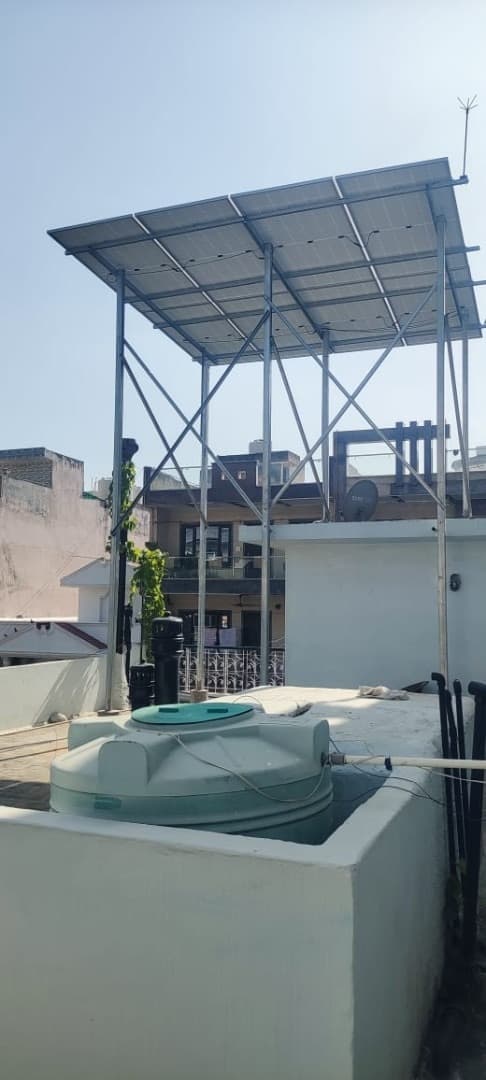
A builder floor's terrace is a working space: water tanks, a staircase head, clotheslines, sometimes a room. The FAQ answers the height question directly. The plant's height can be adjusted to the terrace height, and it can be raised above the water tank. [4] A raised steel structure keeps the terrace usable underneath and lifts the panels clear of the tank's shadow. The same FAQ gives the space rule: 7 to 8 square metres, or 70 to 80 square feet, of shadow-free area per kWp, so about 240 to 300 square feet for a 3 kWp plant. [4] On a shared terrace that area has to be yours to use for the life of the system, which is why the consent comes before the survey.
Access matters for as long as the plant runs. Panels are cleaned from the terrace, the inverter sits near your meter on a dry wall, and the DC cable runs from the roof down to your floor. On a four-floor building the run is longer for the ground floor than for the top floor, and a route through the common stairwell needs the same consent as the roof. Assessing the roof structure for feasibility is the installer's job under the scheme, [4] and Verde Solaire offers a free site evaluation and no-obligation proposal.
Route 1: your own connection on your floor
This is the standard PM Surya Ghar: Muft Bijli Yojana route, and the simplest where the terrace right is yours. The system is wired to your meter, a net meter is installed, and the central subsidy is paid to your bank account: up to ₹78,000 for 3 kW or more. In Delhi the state adds its own subsidy and a per-unit incentive, set out on the Delhi subsidy page. No feasibility study is needed up to 10 kW on the same supply type. [12]
The price is the same as on an independent house. A 3 kW system was published at ₹1,99,000 to ₹2,10,000 before subsidy in July 2025, which in Delhi comes to ₹91,000 to ₹1,02,000 after the central and state subsidy; the 3 kW Delhi page has the working. The nine portal steps are on the how to apply guide, and the Delhi net-metering guide covers the board's process and timelines.
What is different on a builder floor is only the paperwork you bring: the owner's or co-owners' consent for the terrace and, if you rent, the owner's NOC.
Route 2: the society's common-area connection
In a group housing society, or a building run by a residents' welfare association (RWA), the roof is common property and the association is the consumer. The plant is wired to the common-area connection, the one that runs the lifts, pumps and stair lighting, and it is that bill which falls. Your flat's bill does not change under this route.
The subsidy is separate from the household one: ₹18,000 per kW from the centre for common facilities, up to 500 kW (3 kW per house), EV charging included. [4] In Delhi the state adds ₹2,000 per kW, up to 500 kW and a generation-based incentive (GBI) of ₹2 per unit (up to 500 kW, 10 kW per house). The FAQ adds that the 500 kW ceiling includes the individual rooftop plants residents have already installed in the same society. [4]
The document this route turns on is the society's resolution: a decision of the managing committee or general body authorising the plant, the vendor and the signatory. The housing societies page covers common-area plants in more detail.
Route 3: Delhi virtual net metering, since 20 January 2026
Virtual net metering is the route for a shared roof where the flats want the benefit on their own bills. One plant is built on the common roof, and its generation is credited to two or more electricity connections in a proportion the participants agree, under an agreement or memorandum of understanding between them. Delhi has had guidelines for group and virtual net metering since 2019; the Seventh Amendment widened who may use them. In short, the Seventh Amendment of 20 January 2026 opens virtual net metering to all Delhi consumers, with DISCOMs bearing line and network costs up to set caps. [14]
The amendment's wording matters for a building of flats. It makes the framework "applicable for all consumers of NCT of Delhi including consumers of single point of supply", so a building on one bulk connection is not excluded. Participants may change their share of the credit, or add new connections to the arrangement, twice in a financial year with two months' notice. The DISCOMs bear the capital cost of the service line and any network augmentation on the 11 kV network and below, until the cumulative capacity under virtual and group net metering reaches 110 MW for BSES Rajdhani, 100 MW for Tata Power-DDL, 30 MW for BSES Yamuna and 10 MW for NDMC. [14] Subsidy under this metering route is confirmed by BSES Rajdhani's FAQ, and the generation-based incentive is paid by ownership share, provided the consumer has ownership rights in the plant. [4]
Two cautions. The cost waiver runs until each board's cap is reached, so it is not permanent. And the amendment sets the framework, not the board's form; the Delhi net-metering guide will carry the application route as each board publishes it.
What the electricity board asks for on a shared roof
BSES Rajdhani's published list has no separate shared-roof document. What it does require at application is an online application on rts.bsesdelhi.com (helpline 19123, extension 3), the applicant's signature ID proof and scanned signatures. After installation it asks for a single line diagram of the plant, the inverter's IEC certificates and data sheet, the net-metering connection agreement, a photograph of the earth leakage circuit breaker and geotagged photographs of the plant; at inspection, the inspection form and the serial numbers of the inverter and modules. [4] For the subsidy the vendor uploads a domestic content requirement (DCR) undertaking, a cancelled cheque, the consumer-vendor agreement, plant photographs and the electricity bill. [4]
The shared-roof paperwork sits around that list: the owner's NOC where the applicant is a tenant, [4] the participants' agreement or MoU under virtual net metering, [14] and, for a society plant, the resolution naming the signatory. Keep the consent on file for as long as the plant stands. A sale of the top floor or a change of committee should not take the roof with it.
Noida, Greater Noida and Ghaziabad
The three routes exist in Uttar Pradesh in the same shape: your own connection, the society's connection, or a shared plant. The rules behind them come from the state regulator rather than DERC: under the UPERC rooftop solar regulations of 2019, residential users may choose net or gross metering, and the DISCOM allows capacity within transformer limits. [16] The state subsidy for households sits on top of the central one, on the Uttar Pradesh subsidy page.
We have not verified a virtual net metering route for households in Uttar Pradesh, so this page does not describe one. If your society wants one plant credited to several flats in Noida, ask your electricity board in writing before committing, and treat any vendor's assurance as unconfirmed until the board's reply is in hand. The Noida net-metering guide names the board and its process. Verde Solaire is a registered PM Surya Ghar vendor in both Delhi and Uttar Pradesh, and files the application with you in either state.
Sources and dates
The Delhi rules are the DERC (Net Metering for Renewable Energy) (First Amendment) Regulations, 2024 and the Seventh Amendment to the Group Net Metering and Virtual Net Metering Guidelines, dated 20 January 2026, both read in full. The document lists, the tenant NOC, the sanctioned-load rule and the height answer are from BSES Rajdhani's PM Surya Ghar FAQ of September 2025; BSES Yamuna and Tata Power-DDL may word their lists differently. Uttar Pradesh rules are from the UP Solar Energy Policy 2022 and a secondary summary of the UPERC regulations. No customer example on a builder floor or shared roof has been published by Verde Solaire, so none is quoted. Figures checked 16 September 2026.
Questions people ask
Sources
- 1.DERC Group Net Metering and Virtual Net Metering, Seventh Amendment Guidelines — DERC (hosted by Tata Power-DDL), 20 Jan 2026
- 2.PM Surya Ghar Muft Bijli Yojna FAQs — BSES Rajdhani, Sep 2025
- 3.DERC (Net Metering for Renewable Energy) (First Amendment) Regulations, 2024 — DERC (hosted by Tata Power-DDL), 26 Jul 2024
- 4.Uttar Pradesh Solar Energy Policy 2022 — UPNEDA / Government of Uttar Pradesh, 28 Nov 2022
- 5.UPERC (Rooftop Solar PV Grid Interactive Systems) Regulations, 2019, Third Amendment (summary) — TeamLease RegTech, amendment issued 3 Jun 2025
- 6.Solar power plant for residences — Verde Solaire, 27 Feb 2023
- 7.FAQ — Verde Solaire, 12 May 2025
Something out of date? Tell us and we will check it against the source.
Get a written quote with named panels and inverter
A free site survey, a quote that names the make and model of every component, and the subsidy and net-metering paperwork filed for you.