5 kW · all cities
5 kW solar system: price, subsidy, savings
Figures verified on 16 Sept 2026; next review 16 Dec 2026. Every number links to its source on the sources page.
A 5 kW rooftop solar system costs ₹3,25,000 to ₹3,50,000 on Verde Solaire's published price list, before subsidy. After the ₹78,000 central subsidy and the state top-up it comes to ₹2,17,000 to ₹2,42,000 in Noida and ₹2,17,000 to ₹2,42,000 in Delhi, and Delhi adds a generation incentive of ₹13,050 a year for five years. It generates about 563 units a month in Noida and about 544 units a month in Delhi, which is the consumption of a home that runs two or three air conditioners through summer and uses 400 to 600 units a month.
The rest of the page explains why the subsidy on 5 kW is the same rupee amount as on 3 kW, what the extra 2 kW buys, how much roof it needs, and what changes in Delhi and Uttar Pradesh above 3 kW. The Noida and Delhi pages give every capacity for one city.
| City | Published price | Central subsidy | State subsidy | Net payable | Units a month |
|---|---|---|---|---|---|
| Noida | ₹3,25,000 – ₹3,50,000 | − ₹78,000 | − ₹30,000 | ₹2,17,000 – ₹2,42,000 | about 563 |
| Delhi | ₹3,25,000 – ₹3,50,000 | − ₹78,000 | − ₹30,000 + GBI | ₹2,17,000 – ₹2,42,000 | about 544 |
| Greater Noida | ₹3,25,000 – ₹3,50,000 | − ₹78,000 | − ₹30,000 | ₹2,17,000 – ₹2,42,000 | about 563 |
| Ghaziabad | ₹3,25,000 – ₹3,50,000 | − ₹78,000 | − ₹30,000 | ₹2,17,000 – ₹2,42,000 | about 563 |
| Varanasi | ₹3,25,000 – ₹3,50,000 | − ₹78,000 | − ₹30,000 | ₹2,17,000 – ₹2,42,000 | about 563 |
Indicative prices published by Verde Solaire in July 2025. Your written quote is the price. Delhi systems up to 3 kW also earn ₹3 per unit generated for five years (₹2 per unit for 3–10 kW). The UP top-up is confirmed by September 2026 news reports; UPNEDA has not published a 2026 notice.
What a 5 kW system is made of
Ten panels of 540 Wp make 5.4 kWp of modules; Verde Solaire's recent home installations used Adani and Vikram modules of 530 to 545 Wp, and the count follows the wattage named in your quote. Scaling the published 300 to 350 square feet of shadow-free roof for 3 kW, 5 kW needs about 500 to 580 square feet. The inverter is a 5 kW on-grid unit. There is no battery; a hybrid system is a different product.
For a subsidised system, both the modules and the cells must be made in India, and since 1 June 2026 the cells must also appear on the ALMM List-II. GST on solar cells, modules and solar power devices is 5% (since 22 September 2025, down from 12%), shown as its own line on the quote. The published price includes panels, inverter, mounting structure, net metering, installation and warranty; civil work, a load enhancement or a battery are extra. The equipment pages explain the names on a quote.
Why the subsidy stops at 3 kW
The PM Surya Ghar: Muft Bijli Yojana central subsidy is ₹30,000 per kW for the first 2 kW and ₹18,000 for the third, capped at ₹78,000 for any system of 3 kW or more. The fourth and fifth kilowatts receive nothing from the Centre. The state top-ups stop at the same point: Delhi's is capped at ₹30,000 (3 kW) and Uttar Pradesh's at ₹30,000 per consumer, on top of the central subsidy.
So a 5 kW system receives the same ₹1,08,000 as a 3 kW system, against a published price ₹1,26,000 to ₹1,40,000 higher. The subsidy covers roughly half the price of 3 kW and a third of the price of 5 kW, and the extra 2 kW is bought at full price, so 5 kW only makes sense when you will use the extra generation. The 3 kW page has the smaller system's figures, and 3 kW or 5 kW sets the two side by side.
How many units a 5 kW system generates
Verde Solaire's planning yield is 1,500 units per kW per year in Noida and 1,450 in Delhi, and this site takes 10% off that for dust and monsoon. The result is about 563 units a month in Noida and about 544 units a month in Delhi, or about 18 units a day averaged across the year. Generation is not flat: April to June run well above the average and the monsoon and December to January well below, so budget on the annual total, not a May reading. Monsoon and dust in Delhi NCR has the month-by-month picture.
An on-grid system has no battery: midday units are used at once or exported through the net meter and credited against the evening's draw.
Who should buy 5 kW
The published sizing guide is 0–150 units a month: 1–2 kW · 150–300 units: 2–3 kW · above 300 units: above 3 kW. In practice:
- Buy 5 kW if your bills average 400 to 600 units a month across the year, you run two or three air conditioners through summer, and you have about 500 to 580 square feet of roof without midday shade.
- Stay at 3 kW if you average 300 to 400 units: the subsidy covers a larger share of the price, and in Delhi the generation incentive is ₹3 per unit for systems up to 3 kW instead of ₹2 per unit above it.
- Look at 10 kW if you average more than 700 units and have the roof and the sanctioned load; the 10 kW page explains why that size is quoted per site.
Delhi households that averaged 400 units a month or less in FY 2025-26 should read about the state's announced zero-upfront scheme, which offers up to 3 kW at zero upfront cost, "subject to technical feasibility", before paying for a larger system.
Not yet official. Cabinet-approved on 1 September 2026 and reported by the press; the notification and operating rules had not been published when we checked on 16 September 2026. The official Delhi portal still shows the July 2025 figures.
Add up twelve months of bills first; a summer bill alone oversizes the system. The system size calculator does the arithmetic from your units and roof area.
Delhi: sanctioned load, the per-unit incentive and a 10-day connection
Two things change in Delhi above 3 kW. The first is the generation-based incentive (GBI): ₹2 per unit for homes above 3 kW and up to 10 kW, running 5 years from commissioning, paid monthly against the bill; any excess to the bank account. On the planning yield a 5 kW system earns ₹13,050 a year, or ₹65,250 over the five years, on top of the bill saving.
The second is the sanctioned load on your bill. A connection sanctioned below 5 kW is not refused: under the DERC amendment of July 2024, no feasibility study is needed up to 10 kW on the same supply type, and the DISCOM handles any load increase or transformer upgrade. The fixed charge, though, follows the sanctioned load. On the FY 2021-22 schedule it is ₹20 (up to 2 kW), ₹50 (2–5 kW), ₹100 (5–15 kW), ₹200 (15–25 kW) and ₹250 (above 25 kW) per kW per month, so a 5 kW load costs ₹250 a month before surcharges. Under the DERC guidelines of July 2026 the connection timeline for systems up to 10 kW is 10 days, with no application fee for domestic systems. The Delhi net-metering page covers BSES Rajdhani, BSES Yamuna and Tata Power-DDL, and 5 kW in Delhi has the Delhi-only figures.
Uttar Pradesh: the state top-up and two Noida boards
Uttar Pradesh adds ₹15,000 per kW, capped at ₹30,000 per consumer, on top of the central subsidy, under the UP Solar Energy Policy 2022.
Not yet official. Confirmed by news reports in September 2026; UPNEDA's site did not load when we checked, so there is no official 2026 confirmation.
Noida city is served by PVVNL (Paschimanchal Vidyut Vitran Nigam Limited, a UPPCL company) and Greater Noida by NPCL (Noida Power Company Limited). Many pages and AI answers say NPCL for both; the name on your bill settles it. In Uttar Pradesh, under the UPERC rooftop solar regulations of 2019, residential users may choose net or gross metering, and the DISCOM allows capacity within transformer limits, which is where a 5 kW request on a crowded transformer can be trimmed. The Noida net-metering page has the process, and 5 kW in Noida the Noida-only figures. Greater Noida, Ghaziabad and Varanasi get the same subsidy and the same net price, on NPCL, PVVNL and PUVVNL respectively.
Not yet official. From a secondary source; confirm against your electricity bill.
What the bill does after 5 kW
The energy charge on a 400 to 600 unit bill is where the money goes, and a 5 kW system removes most of it. The fixed charge stays. In Uttar Pradesh it is ₹110 per kW per month of sanctioned load, so the bill never reaches zero; the honest claim is that the energy charge largely disappears. On the calculator's assumptions the net price of a 5 kW system is recovered in about four to six years, faster in Delhi because of the incentive. The July 2025 price posts list 25-year performance warranties on all three panel types.
Not yet official. From a secondary summary of the UPERC order.
The bill calculator takes your units and sanctioned load and shows the before and after on the Delhi and Uttar Pradesh slabs.
Paying for it
The PM Surya Ghar concessional loan is collateral-free, from nationalised banks, at repo rate plus 0.5 percentage points, which was 5.75% on 28 July 2026, over 10 years. Financing the full net price of a 5 kW system at that rate and tenure is an EMI of about ₹2,400 to ₹2,700 a month, below the calculator's monthly saving for a home that uses everything the system generates. Verde Solaire has tie-ups with SIDBI, SBI and other NBFCs for collateral-free solar loans and prepares the application with you. The EMI calculator takes any rate and tenure; the solar loan page lists the options. The scheme ends on 31 March 2027, and the subsidy is claimed after commissioning, so the system has to be installed and inspected before then.
What AI answers say about the 5 kW price
On 16 September 2026 we asked ChatGPT, Claude, Gemini, Perplexity and Google AI Overviews what a 5 kW on-grid system costs in Delhi and in Noida after subsidy, most of them twice. The eighteen answers put the net price anywhere from ₹1.45 lakh to ₹2.82 lakh, because each engine drew on different installers' pages and some applied the wrong rules: two Delhi answers deducted the old state subsidy of ₹2,000 per kW, maximum ₹10,000 (replaced in July 2025), and five of the nine Noida answers left the Uttar Pradesh top-up out of the figure or called it uncertain. This page uses one dated price list and the rules as published, with the source beside each; what AI answers get wrong lists the thirteen most common errors.
A 5 kW system Verde Solaire has installed
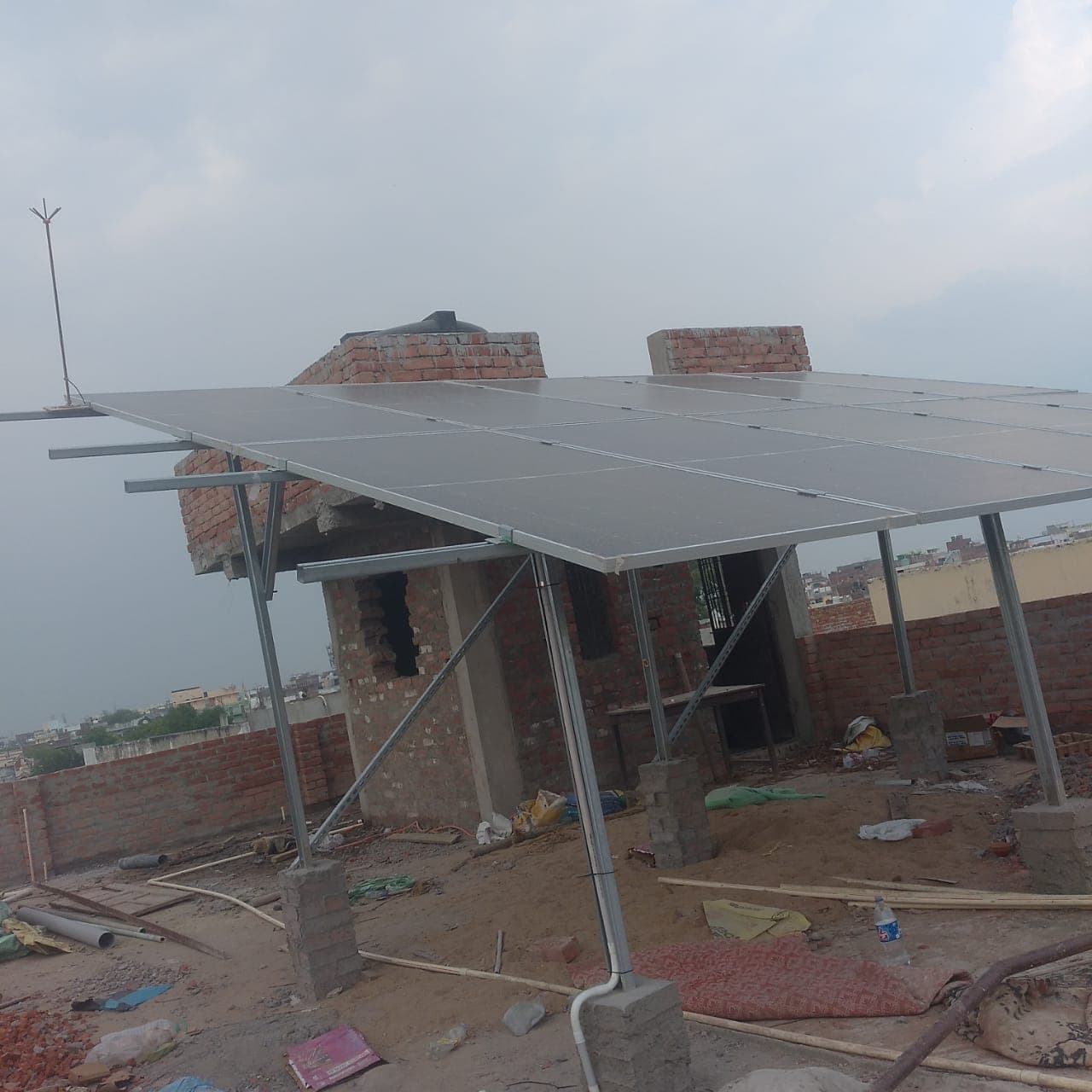
Verde Solaire published a 5 kW installation in Varanasi under PM Surya Ghar in June 2024, and the company is a registered PM Surya Ghar vendor in both Delhi and Uttar Pradesh. Sushma Pandey, who had a 5 kW plant installed in Varanasi, wrote that the team was "professional and efficient" and that "My electricity bills have noticeably decreased". The Varanasi 5 kW project page has the details, and the company offers a free site evaluation and no-obligation proposal before any quote.
Assumptions and limits
- Prices are Verde Solaire's published July 2025 ranges (Delhi post of 14 July 2025, Noida post of 10 July 2025); the written quote after a survey is the price.
- Central subsidy per PM Surya Ghar (PIB, 29 February 2024; BSES Rajdhani FAQ, September 2025). Delhi state subsidy per the Delhi Solar Portal; Uttar Pradesh per the UP Solar Energy Policy 2022, with continuation in 2026 confirmed only by news reports.
- Generation uses the published planning yield of 1,500 units per kW per year for Noida and 1,450 for Delhi, less a 10% derate for dust and monsoon. The panel count assumes 540 Wp modules; the roof area scales the published 300 to 350 square feet per 3 kW.
- The EMI is arithmetic at 5.75% over 10 years on the net price; the loan rate is repo-linked and moves.
- AI answers were collected on 16 September 2026 and reflect that snapshot.
- Scheme end date 31 March 2027; figures verified on 16 September 2026.
Questions people ask
Sources
- 1.Solar Panel Price in Delhi – 2025 Cost, Subsidy & EMI Explained — Verde Solaire, 14 Jul 2025
- 2.Solar Panel Price in Noida & Greater Noida – 2025 Cost, Subsidy & EMI Explained — Verde Solaire, 10 Jul 2025
- 3.3 kW Solar Panel Price in Delhi (With Subsidy & Easy Loan – 2025 Guide) — Verde Solaire, 28 Jun 2025
- 4.Cabinet approves PM-Surya Ghar: Muft Bijli Yojana — PIB / MNRE, 29 Feb 2024
- 5.PM Surya Ghar Muft Bijli Yojna FAQs — BSES Rajdhani, Sep 2025
- 6.PM Surya Ghar: Subsidy Support and Low-Interest Financing (Rajya Sabha reply) — PIB / MNRE, 28 Jul 2026
- 7.MNRE clarifies ALMM List-II exemption for PM Surya Ghar users — TaiyangNews, 9 Jun 2026
- 8.GST on solar cells, modules cut to 5% — pv magazine India, 4 Sep 2025
- 9.State Subsidy — Delhi Solar Portal, GNCTD, undated (checked 18 Sep 2026)
- 10.Uttar Pradesh Solar Energy Policy 2022 — UPNEDA / Government of Uttar Pradesh, 28 Nov 2022
- 11.PM Surya Ghar: India's Solar Revolution (backgrounder) — PIB / MNRE, 13 Mar 2025
- 12.DERC (Net Metering for Renewable Energy) (First Amendment) Regulations, 2024 — DERC (hosted by Tata Power-DDL), 26 Jul 2024
- 13.DERC (Net Metering for Renewable Energy) (Second Amendment) Guidelines, 2026 — DERC (hosted by Tata Power-DDL), 16 Jul 2026
- 14.Electricity Tariff for FY 2021-22: Press Note and Tariff Schedule — DERC, 30 Sep 2021
- 15.Electricity rate per unit in Noida & Greater Noida (2026) — noidarent.com, updated Jul 2026
- 16.Delhi: Solar policy gets major push, 2.30 lakh rooftops targeted by March 2027 — ANI, 1 Sep 2026
- 17.Solar power installation of 5 KW in Varanasi under PM Surya Ghar — Verde Solaire, 1 Jun 2024
- 18.Testimonials, page 1 — Verde Solaire, fetched 18 Sep 2026
- 19.Verde Solaire: SEO & AEO Strategy (directory listings and credentials compiled from Justdial, IndiaMART and government registries) — Millennial AI, 12 Sep 2026
Something out of date? Tell us and we will check it against the source.
Get a written quote with named panels and inverter
A free site survey, a quote that names the make and model of every component, and the subsidy and net-metering paperwork filed for you.