Varanasi · PUVVNL
Rooftop solar price in Varanasi, 1 to 10 kW
Figures verified on 16 Sept 2026; next review 16 Dec 2026. Every number links to its source on the sources page.
A 3 kW rooftop solar system in Varanasi costs ₹1,99,000 to ₹2,10,000 on Verde Solaire's published July 2025 price list. After the ₹78,000 central subsidy under PM Surya Ghar: Muft Bijli Yojana and the ₹30,000 Uttar Pradesh top-up, the amount you pay is ₹91,000 to ₹1,02,000. On the planning yield this site uses for Uttar Pradesh the system produces about 338 units a month; the company's own Varanasi guide of 1 July 2025 gave 360 to 400 units a month, enough for a home running two to four air conditioners. [vs-varanasi-3kw]
That is the answer most people come for. The rest of the page gives the same figures for 1, 2, 5 and 10 kW, explains which electricity board handles the net meter in Varanasi and what choice the UPERC rules give you, shows what happens to the bill afterwards, and lists every assumption, so that the written quote you receive after a roof survey matches what you read here.
The price table for Varanasi
| System | Published price | Central subsidy | Uttar Pradesh state subsidy | Net payable | Units a month |
|---|---|---|---|---|---|
| 1 kW | ₹70,000 – ₹80,000 | − ₹30,000 | − ₹15,000 | ₹25,000 – ₹35,000 | about 113 |
| 2 kW | ₹1,35,000 – ₹1,50,000 | − ₹60,000 | − ₹30,000 | ₹45,000 – ₹60,000 | about 225 |
| 3 kW | ₹1,99,000 – ₹2,10,000 | − ₹78,000 | − ₹30,000 | ₹91,000 – ₹1,02,000 | about 338 |
| 5 kW | ₹3,25,000 – ₹3,50,000 | − ₹78,000 | − ₹30,000 | ₹2,17,000 – ₹2,42,000 | about 563 |
| 10 kW | On request | − ₹78,000 | − ₹30,000 | Quote-based | about 1,125 |
Indicative prices published by Verde Solaire in July 2025. Your written quote is the price. Generation uses the published planning yield with a 10% derate for dust and monsoon. The UP top-up is confirmed by September 2026 news reports; UPNEDA has not published a 2026 notice.
Each published price covers panels, inverter, mounting structure, net metering, installation and warranty. The Varanasi guide used the same 3 kW range as the Delhi and Noida posts of the same month; what changes between cities is the state top-up and the electricity board, not the hardware.
The central subsidy is ₹30,000 per kW for the first 2 kW and ₹18,000 for the third, so it reaches its ceiling of ₹78,000 at 3 kW and stays there for anything larger. Uttar Pradesh adds ₹15,000 per kW under its Solar Energy Policy 2022, capped at ₹30,000 per consumer, on top of the central subsidy, and it is paid on top of the central amount, not instead of it. The Uttar Pradesh subsidy page has the history and the payout timing.
Not yet official. Confirmed by news reports in September 2026; UPNEDA's site did not load when we checked, so there is no official 2026 confirmation.
A 10 kW system is quoted per site. The structure, the cable runs and the inverter choice vary far more on a large roof than on a 3 kW one, and the subsidy does not grow with it: ₹78,000 central plus ₹30,000 per consumer, on top of the central subsidy state, the same as on 3 kW.
Which size: 2, 3 or 5 kW
The subsidy formula pays 60% of the benchmark cost for the first 2 kW and 40% for the third, then nothing. That is why 3 kW is the size at which the combined ₹1,08,000 covers roughly half the published price, and why most Varanasi homes with two to four air conditioners land there.
Two kilowatts can still be the right answer. Verde Solaire's first PM Surya Ghar installation in Varanasi, published on 22 March 2024, was a 2 kW plant with Adani 540 Wp modules and a KSolare inverter. On 2 kW the central subsidy is ₹60,000 and the Uttar Pradesh top-up already reaches its cap at ₹30,000, leaving ₹45,000 to ₹60,000 to pay. [vs-post-82] That post also repeated the scheme's line about 300 free units a month. To be exact: 300 units is what the scheme expects a roughly 3 kW system to generate, not an allowance credited to your bill. What you save is the electricity you no longer buy.
Five kilowatts suits a home using more than about 400 units a month. The subsidy is the same rupee amount as on 3 kW against a higher price, so the net payable is ₹2,17,000 to ₹2,42,000 and the cost per kW rises; the 5 kW page and 3 kW vs 5 kW set out the arithmetic. Verde Solaire published a 5 kW installation in Varanasi on 1 June 2024, and its owner, Sushma Pandey, wrote that her "electricity bills have noticeably decreased". [vs-post-100]
The official sizing guide is 0–150 units a month: 1–2 kW · 150–300 units: 2–3 kW · above 300 units: above 3 kW. Use twelve months of bills, not the summer ones alone; a system sized to June will sit idle for half the year.
Net metering in Varanasi: PUVVNL, and the choice UPERC gives you
Under the UPERC rooftop solar regulations of 2019, under the UPERC rooftop solar regulations of 2019, residential users may choose net or gross metering, and the DISCOM allows capacity within transformer limits. The difference matters. With net metering, the units you export are set off against the units you import and you pay for the difference. With gross metering, everything the roof generates is sold to the distributor at a fixed rate and everything the house uses is bought at the domestic tariff. For a home, net metering is the usual choice, because a unit you avoid buying is worth more to you than a unit you sell.
The third amendment to those regulations set the rate for surplus injected into the grid at the weighted-average large-solar tariff plus 25% (Third Amendment, in force from July 2025).
Not yet official. Read through a secondary summary; the gazette text was not checked.
For a subsidised system the application starts on the national portal, pmsuryaghar.gov.in, where you register with your state, electricity distributor, consumer number and mobile number, and choose a vendor registered on the portal. The distributor then gives feasibility approval, the vendor installs, the net-meter application is filed with the plant details, the distributor inspects, and the commissioning certificate on the portal triggers the subsidy claim. Across Uttar Pradesh, UPNEDA is the state nodal agency, and its district solar cells help with installation and net metering. We have verified only this framework for PUVVNL, not its own portal screens or timelines, so this page does not list them; the PUVVNL application pack records what is verified and what we file on your behalf, and the Varanasi net-metering page walks through the stages.
Verde Solaire is a registered PM Surya Ghar vendor in both Delhi and Uttar Pradesh, and its Varanasi customers have written about the paperwork specifically: Mahender Nath Mishra named the engineer who "helped in all the processes including documentations for net metering".
What the electricity bill does after solar
Uttar Pradesh urban domestic energy charges for FY 2026-27 are ₹5.50 (0–150 units), ₹6.00 (151–300), ₹6.50 (301–500) and ₹7.00 (above 500) per unit.
Not yet official. Taken from secondary summaries of the FY 2026-27 UPERC order; the order itself was not fetched.
A house using 350 to 400 units a month pays across the first three slabs. A 3 kW system generating about 338 units a month removes most of those units, so the energy charge largely disappears. What remains is the fixed charge of ₹110 per kW per month on your sanctioned load, plus whatever the roof did not cover. The fixed charge does not go away, which is why no honest page promises a zero bill. Put your own units and sanctioned load into the bill calculator to see the before and after.
Not yet official. From a secondary summary of the UPERC order.
On payback, the July 2025 guide put it inside three years with the subsidy. The calculator on this page, which assumes the house uses everything the system generates and applies the derate listed at the bottom, lands at about four years for 3 kW. Three to five years is the honest planning range; anything shorter needs your actual bills to back it.
Paying for it: cash, loan or EMI
The PM Surya Ghar concessional loan is collateral-free, from nationalised banks, priced at repo rate plus 0.5 percentage points, which came to 5.75% on 28 July 2026, over 10 years. On the 3 kW net price the EMI is smaller than the monthly saving the calculator below shows, which is the point of the scheme. Older pages, and many AI answers, still quote the 2024 and 2025 rates; both are superseded. Verde Solaire has tie-ups with SIDBI, SBI and other NBFCs for collateral-free solar loans and prepares the application with you. Its July 2025 Varanasi guide advertised an upfront payment of ₹10,000 with the balance on a subsidised loan; ask for the current terms in writing with the quote. The EMI calculator takes any rate and tenure.
Equipment and compliance
A subsidised system must use both the modules and the cells must be made in India, and from 1 June 2026 the cells must appear on ALMM List-II. GST on solar modules and devices is 5% (since 22 September 2025, down from 12%). The Varanasi installations Verde Solaire has published used Adani 540 Wp modules with KSolare inverters, and the company's July 2025 price posts state 25-year performance warranties on all three panel types. Every quote names the make and model so you can check them against the approved lists yourself; panels, inverters and batteries explains what the names mean.
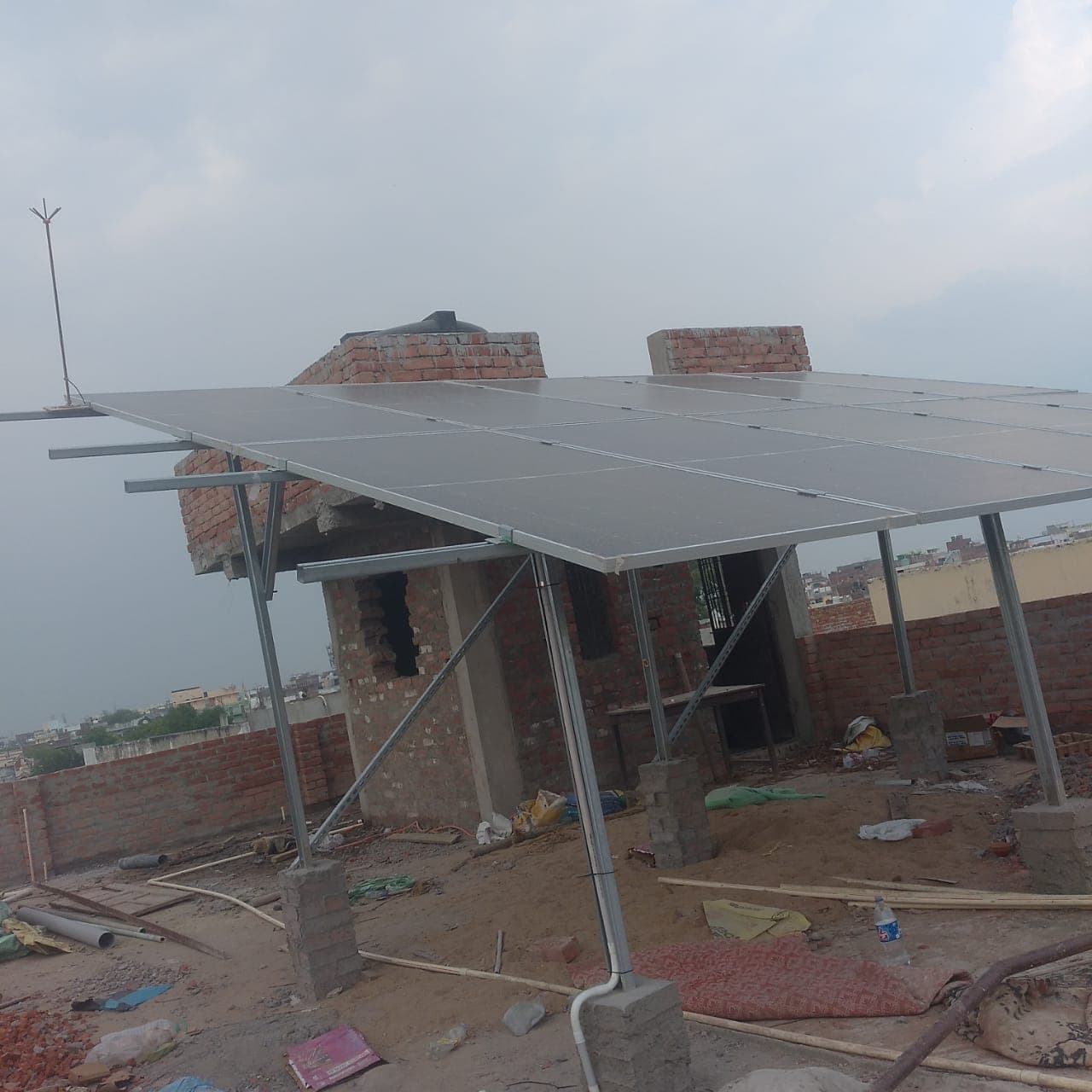
Where we work in Varanasi
Verde Solaire's Varanasi branch is at Laxmi Niwas, Chetgunj, with the head office in Noida behind it. The company announced its Varanasi rooftop service in a post of 29 March 2024, which also quoted a state government target of 25,000 solar rooftops in the city. [vs-post-88] The July 2025 guide listed Lanka, Sigra, Bhelupur, DLW and Cantt, and adjoining areas, as the neighbourhoods served. Independent houses are the simplest case. For a flat or a shared building the roof right and the sanctioned load on your own connection decide what can be installed, which the installation page for Varanasi covers. Every enquiry starts with a free site evaluation and no-obligation proposal.
“I recently had a 5 KW solar power plant installed in Varanasi by Verde Solaire, and I am extremely satisfied with the results! The installation process was seamless, and their team was professional and efficient. My electricity bills have noticeably decreased, and I feel great knowing I'm contributing to a greener environment. I highly recommend Verde Solaire for anyone considering solar power solutions!”

Sushma Pandey 5 kW · Varanasi
“I am very happy with the installation team and systems of Verde Solaire. The company installed my solar plant in very quick time. Special mention to Mr. Sachin Dubey of the firm who helped in all the processes including documentations for net metering. I can say with certainty that Verde is the best solar plant installation company in Varanasi.”

Mahender Nath Mishra Varanasi
Assumptions behind these figures
- Prices are Verde Solaire's published July 2025 ranges, identical across its Delhi, Noida and Varanasi posts; the written quote after a survey is the price.
- Central subsidy per PM Surya Ghar (PIB, 29 February 2024; BSES FAQ, September 2025). Uttar Pradesh subsidy per the UP Solar Energy Policy 2022 and the UPNEDA brochure of February 2024, continuation confirmed by September 2026 news reports only.
- Generation uses the planning yield of 1,500 units per kW per year that the company published for Noida, with a 10% derate for dust and monsoon. Verde Solaire has not published a Varanasi-specific yield; its 2025 guide's 360 to 400 units a month for 3 kW is quoted above as the company's figure.
- Tariffs are from secondary summaries of the FY 2026-27 UPERC order.
- PUVVNL's application steps beyond the UPERC and national-portal framework were not verified.
- Scheme end date 31 March 2027; ALMM List-II from 1 June 2026.
Questions people ask
Sources
- 1.3 kW Solar Panel Price in Varanasi (With Subsidy & Easy Loan – 2025 Guide) — Verde Solaire, 1 Jul 2025
- 2.Rooftop Solar Power Plant installation company in Varanasi — Verde Solaire, 29 Mar 2024
- 3.Solar Power Plant of 2 KW in Varanasi under PM Surya Ghar — Verde Solaire, 22 Mar 2024
- 4.Solar power installation of 5 KW in Varanasi under PM Surya Ghar — Verde Solaire, 1 Jun 2024
- 5.Purvanchal Vidyut Vitran Nigam Limited (Varanasi headquarters) — PUVVNL / UPPCL, checked 18 Sep 2026
- 6.Cabinet approves PM-Surya Ghar: Muft Bijli Yojana — PIB / MNRE, 29 Feb 2024
- 7.PM Surya Ghar Muft Bijli Yojna FAQs — BSES Rajdhani, Sep 2025
- 8.PM Surya Ghar: Subsidy Support and Low-Interest Financing (Rajya Sabha reply) — PIB / MNRE, 28 Jul 2026
- 9.MNRE clarifies ALMM List-II exemption for PM Surya Ghar users — TaiyangNews, 9 Jun 2026
- 10.GST on solar cells, modules cut to 5% — pv magazine India, 4 Sep 2025
- 11.Uttar Pradesh Solar Energy Policy 2022 — UPNEDA / Government of Uttar Pradesh, 28 Nov 2022
- 12.Grid-Connected Rooftop Solar System for Residential Consumers (brochure) — UPNEDA, 21 Feb 2024
- 13.PM Surya Ghar Yojana: solar panel subsidy up to Rs 1.08 lakh in UP — Business Today Bazaar, 9 Sep 2026
- 14.Electricity rate per unit in Noida & Greater Noida (2026) — noidarent.com, updated Jul 2026
- 15.UPERC (Rooftop Solar PV Grid Interactive Systems) Regulations, 2019, Third Amendment (summary) — TeamLease RegTech, amendment issued 3 Jun 2025
- 16.PM Surya Ghar: India's Solar Revolution (backgrounder) — PIB / MNRE, 13 Mar 2025
- 17.Our Branches — Verde Solaire, 20 Feb 2024
- 18.Testimonials, page 1 — Verde Solaire, fetched 18 Sep 2026
- 19.Testimonials, page 2 — Verde Solaire, fetched 18 Sep 2026
Something out of date? Tell us and we will check it against the source.
Get a written quote with named panels and inverter
A free site survey, a quote that names the make and model of every component, and the subsidy and net-metering paperwork filed for you.