Delhi · BSES Rajdhani
Rooftop solar price in Delhi, 1 to 10 kW
Figures verified on 16 Sept 2026; next review 16 Dec 2026. Every number links to its source on the sources page.
A 3 kW rooftop solar system in Delhi costs ₹1,99,000 to ₹2,10,000 on Verde Solaire's published price list, and ₹91,000 to ₹1,02,000 after the ₹78,000 central subsidy under PM Surya Ghar: Muft Bijli Yojana and the ₹30,000 Delhi state subsidy. Delhi then pays a generation-based incentive (GBI) of ₹3 per unit on everything the system produces, which on about 326 units a month comes to about ₹11,745 a year, for five years.
That is the answer for the size most Delhi homes ask about. The rest of this page gives the same figures for 1, 2, 5 and 10 kW, what each electricity board requires for the net meter, what the bill does afterwards, where the zero-upfront scheme announced in September 2026 stands, and the assumptions behind every number.
The price table for Delhi
| System | Published price | Central subsidy | Delhi state subsidy | Net payable | Units a month |
|---|---|---|---|---|---|
| 1 kW | ₹70,000 – ₹80,000 | − ₹30,000 | − ₹10,000 | ₹30,000 – ₹40,000 | about 109 |
| 2 kW | ₹1,35,000 – ₹1,50,000 | − ₹60,000 | − ₹20,000 | ₹55,000 – ₹70,000 | about 218 |
| 3 kW | ₹1,99,000 – ₹2,10,000 | − ₹78,000 | − ₹30,000 | ₹91,000 – ₹1,02,000 | about 326 |
| 5 kW | ₹3,25,000 – ₹3,50,000 | − ₹78,000 | − ₹30,000 | ₹2,17,000 – ₹2,42,000 | about 544 |
| 10 kW | On request | − ₹78,000 | − ₹30,000 | Quote-based | about 1,088 |
Indicative prices published by Verde Solaire in July 2025. Your written quote is the price. Generation uses the published planning yield with a 10% derate for dust and monsoon.
The published price covers panels, inverter, mounting structure, net metering, installation and warranty. The central subsidy is ₹30,000 per kW for the first 2 kW plus ₹18,000 for the third, capped at ₹78,000 for 3 kW and above. Delhi adds ₹10,000 per kW, capped at ₹30,000 (3 kW), under the July 2025 amendment to the Delhi Solar Energy Policy, which runs from 14 March 2024 to 13 March 2027.[8] The two are paid on top of each other. A page or an AI answer that quotes ₹2,000 per kW, maximum ₹10,000 (replaced in July 2025) is describing the policy as it stood before July 2025.
A 10 kW system is priced per site because structure, cable run and inverter choice vary far more between roofs. The subsidy on it is the same ₹78,000 plus ₹30,000 (3 kW), and the GBI steps down to ₹2 per unit.
The incentive Delhi pays that Uttar Pradesh does not
Delhi pays for generation as well as for installation. The GBI is ₹3 per unit for home systems up to 3 kW and ₹2 per unit for systems above 3 kW up to 10 kW, for 5 years from commissioning, paid monthly against the bill; any excess to the bank account. On the planning yield used across this site, a 3 kW system earns ₹11,745 a year, or ₹58,725 over the five years. A 5 kW system earns ₹13,050 a year, because the rate steps down but the units go up.
The incentive is claimed separately from the central subsidy: subsidised systems: apply on the PM Surya Ghar portal and claim the Delhi subsidy and GBI on solar.delhi.gov.in; unsubsidised systems: the DISCOM portal. Verde Solaire files both applications. AI answers often quote the lower rate for every home; the higher rate applies to any home system of 3 kW or less.
Why 3 kW, and when 5 kW makes sense
The subsidy formula is 60% of the benchmark cost for the first 2 kW and 40% for the part between 2 and 3 kW, capped at 3 kW. The combined ₹1,08,000 therefore covers roughly half of the published 3 kW price, and nothing more is added above 3 kW. At 5 kW the same subsidy sits against a higher price, so the net cost per kW rises; the extra 2 kW still generates at the same rate, and a home using more than about 400 units a month usually needs it. The official sizing guide is 0–150 units a month: 1–2 kW · 150–300 units: 2–3 kW · above 300 units: above 3 kW. Average twelve months of bills, not the June one.
The Delhi 3 kW page and the Delhi 5 kW page work each size through in full; the sizing guide covers the roof-area and sanctioned-load checks.
Which electricity board you are on, and what it requires
Delhi has three distribution licensees and one municipal area. BSES Rajdhani serves south and west Delhi, BSES Yamuna serves east and central Delhi, and Tata Power-DDL serves north and north-west Delhi; the NDMC area is served by the New Delhi Municipal Council and is handled separately. The name at the top of your bill decides the portal. BSES Rajdhani uses rts.bsesdelhi.com (helpline 19123, extension 3), Tata Power-DDL has the net-metering application and manual on tatapower-ddl.com, and for subsidised systems in every area PM Surya Ghar applicants apply through the national portal; everyone else through the DISCOM or state portal.
Under the DERC net-metering guidelines amended on 16 July 2026, a domestic connection up to 10 kW is to be connected within 10 days and there is no application fee; above 10 kW the timeline is 25 days.[13] Since the 2024 amendment, no feasibility study is needed up to 10 kW on the same supply type, and the DISCOM handles any load increase or transformer upgrade.[12] Surplus generation is not lost: credits roll over month to month, and any surplus left at the end of the financial year is paid at the DISCOM's average power purchase cost.
Those are the rules; practice has been slower. Arun Sibal, whose New Delhi house was fitted within days of payment, wrote that the only issue was "the time taken in installing the net meter from BSES, which was actually not in control of Verde", and that the team kept him informed throughout. Verde Solaire is a registered PM Surya Ghar vendor in both Delhi and Uttar Pradesh and is registered with IOCL, UHBVN, DHBVN, CEL, IPGCL, BRPL and CREST for solar power plant installations. The process for each board is on the Delhi net-metering page, with guides for BSES Rajdhani, BSES Yamuna and Tata Power-DDL.
What a Delhi electricity bill does after solar
DERC's last published domestic tariff schedule, for FY 2021-22, charges ₹3.00 (0–200 units), ₹4.50 (201–400), ₹6.50 (401–800), ₹7.00 (801–1,200) and ₹8.00 (above 1,200) per unit, plus a fixed charge of ₹20 (up to 2 kW), ₹50 (2–5 kW), ₹100 (5–15 kW), ₹200 (15–25 kW) and ₹250 (above 25 kW) per kW per month, a regulatory surcharge of 8% and a fuel surcharge that changes monthly and stood at 17.94% for BSES Rajdhani in June 2026.
Not yet official. Revised every month; this is the June 2026 figure as reported.
A home on 400 units a month sits at the top of the second slab. A 3 kW system generating about 326 units a month removes most of that consumption, and the two surcharges, which the calculator applies to the energy and fixed charges together, fall with it. The fixed charge stays, which is why the bill does not become zero. On the calculator's default assumptions the net cost of a 3 kW system in Delhi is recovered in about three to four years once the GBI is counted. The bill calculator does the arithmetic for your own units and sanctioned load, and the Delhi tariff explainer walks through each line of the bill.
Delhi's free-power subsidy is separate. It is 0–200 units a month free; 201–400 units at 50% off, capped at ₹800 a month; you must opt in, and with solar it is worked out on net units, that is import minus export. A home that imports fewer than 200 net units pays a near-zero energy charge either way, so the saving from solar is smaller for a subsidised household than the tariff alone suggests. The calculator does not model the free-power subsidy; treat its savings figure as an upper bound if you receive it.
Not yet official. Trade and news reports; no DERC or GNCTD order was cited.
The zero-upfront scheme: approved, not yet notified
On 1 September 2026 the Delhi Cabinet approved a second amendment offering up to 3 kW at zero upfront cost, "subject to technical feasibility" to households that averaged 400 units a month or less in FY 2025-26.[9] As of 16 September 2026 the notification and operating rules had not been published and the official portal still showed the July 2025 subsidy described above, so there was no notified route to apply under it when we checked. If you use more than 400 units a month, or want more than 3 kW, the scheme as announced does not cover you and the paid route on this page is the one that applies. The zero-upfront explainer tracks what is approved, what is notified and the questions still open.
Not yet official. Cabinet-approved on 1 September 2026 and reported by the press; the notification and operating rules had not been published when we checked on 16 September 2026. The official Delhi portal still shows the July 2025 figures.
Paying for it: cash, loan or EMI
The PM Surya Ghar concessional loan is collateral-free, from nationalised banks, priced at repo rate plus 0.5 percentage points, which was 5.75% on 28 July 2026, over 10 years.[3] Answers that quote around 7% (February 2024 figure, superseded) are repeating an old number. On the mid-point of the 3 kW net price the EMI comes out below the monthly saving on the calculator's defaults.
Verde Solaire has tie-ups with SIDBI, SBI and other NBFCs for collateral-free solar loans and prepares the paperwork with you. In July 2025 it published a Delhi offer under which the customer paid ₹10,000 upfront and financed the balance by EMI; the loan rate has changed since, so ask for the current terms in writing before you rely on them. The EMI calculator takes any principal, rate and tenure, and the solar loan page lists the lenders and documents.
Equipment and compliance
A subsidised system must use both the modules and the cells must be made in India, and from 1 June 2026 the cells must appear on the ALMM List-II as well as the modules.[27] GST on solar equipment is 5% (since 22 September 2025, down from 12%).[29]
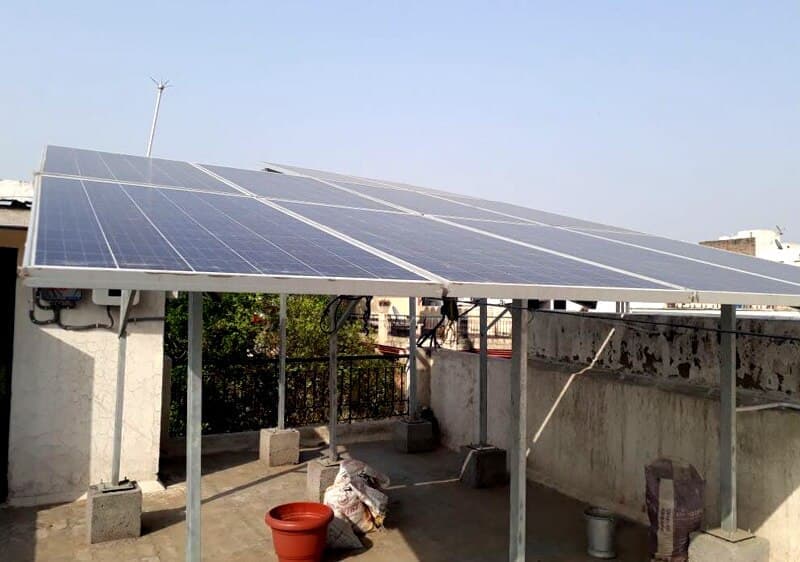
Verde Solaire's published Delhi installations include a 10 kW system in Greater Kailash on Adani bifacial modules, where the customer wrote that the company fitted a better bifacial panel than the one agreed "without charging anything extra from us", and a 10 kW system in Janakpuri on Vikram modules with KSolare inverters. The company publishes 25-year performance warranties on all three panel types. Every quote names the make, model and wattage of each component so that you can check them against the approved lists; panels, inverters and batteries explains what the names mean, and the Greater Kailash and Janakpuri project pages show the two systems.
Where in Delhi we install
Verde Solaire's registered office is in Sarvodaya Enclave, New Delhi, and its July 2025 price post lists the areas it serves as Saket, CR Park, Greater Kailash and Defence Colony in the south; Preet Vihar, Laxmi Nagar and Mayur Vihar in the east; Janakpuri, Dwarka and Rajouri Garden in the west; Model Town, Rohini and Ashok Vihar in the north; and Karol Bagh, Patel Nagar and Daryaganj in central Delhi, along with NDMC colonies. Independent houses and builder floors both work; on a builder floor the roof right and the sanctioned load on your connection decide the size, which the builder floors guide explains. The Delhi installation page covers the survey, the shadow analysis and the structure; the company offers a free site evaluation and no-obligation proposal.
Customers in Delhi have described the work in their own words. S. C. Garg's Greater Kailash system, installed when the company still traded as Sirius Electric, has "been working continuously without a single day breakdown since 2017". K. K. Sharma in Chhatarpur was "highly impressed with their shadow analysis process". The reviews below are reproduced as written.
“I got a 10 KW solar system installed at my house in Janakpuri, New Delhi from Verde Solaire Pvt. Ltd. I used Vikram solar panels and KSolare inverters with an elevated module mounting structure. The installation of solar plant by Verde was of very good quality and their installation of solar system was also very quick. However the net metering process was delayed by the Discom and the electricity department has to look into this. I would recommend Verde to everyone who wants to install solar plant and save on their electricity bill.”

Navin Verma 10 kW · New Delhi
“I had installed solar plant from Verde (formerly Sirius Electric) more than five years back at my GK, New Delhi residence. This was a very good decision, as my electricity bill has been low since then. Verde (formerly Sirius) had used such good materials that the solar system has been working continuously without a single day breakdown since 2017. The solar plant installed at my place is maintenance free. I have recommended installation of solar system from Verde Solaire to many of my friends and neighbours in New Delhi NCR.”

Mr. S. C. Garg New Delhi
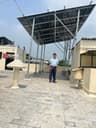
“Solar rooftop energy system of 10 KW was installed by Verde Solaire at my GK1, New Delhi residence. I am very happy with the professional services provided by the company. We had agreed for 530W Mono Perc Adani solar panels for my solar energy system, but they installed a better bifacial solar panel of Adani without charging anything extra from us. Verde Solaire in my opinion is one of the best solar plant installation company in Delhi NCR. The processes were simple and they have also helped in applying for central subsidy for solar power plant. This company is highly recommended by us for installation of solar power plant.”
Mr. Jai Kumar Manghnani 10 kW · New Delhi
“I got a 110 KW solar power plant installed at my factory, Marwar Carpets, Panipat from Verde Solaire Pvt Ltd. The company completed the work in record time with high quality solar panels from Vikram and solar inverters from Schneider. The savings in electricity bill is huge from this solar plant installation at my Panipat factory. In fact Verde Solaire had first installed a 20 KW solar plant at my residence in New Delhi. The order for the Panipat factory was given later on to them when I started getting lower electricity bill at my residence. Verde Solaire is highly recommended as a solar power installation company for high quality and timely work.”

Mr. Nikunj Aggarwal 110 kW · New Delhi
Run the figures for your own roof: change the size, units and board, and the calculator shows price, subsidy, GBI, saving and payback.
Assumptions behind these figures
- Prices are Verde Solaire's published July 2025 ranges; the written quote after a free site survey is the price.
- Central subsidy per PM Surya Ghar (PIB, 29 February 2024; BSES Rajdhani FAQ, September 2025). Delhi state subsidy and GBI per the Delhi Solar Portal and the July 2025 amendment reported by Mercom India; the 1 September 2026 amendment is Cabinet-approved but not notified.
- Generation uses the planning yield of 1,450 units per kW per year for Delhi with a 10% derate for dust and monsoon, which gives about 326 units a month for 3 kW; Verde Solaire's June 2025 post quoted 360 to 400 units.
- Bills use the DERC FY 2021-22 schedule, the 8% regulatory surcharge and the June 2026 BSES Rajdhani fuel surcharge; the free-power subsidy, taxes and duties are not modelled.
- Net-metering timelines and fees per the DERC Second Amendment Guidelines of 16 July 2026.
- Scheme end date 31 March 2027; GST rate since 22 September 2025; loan rate as of 28 July 2026.
Questions people ask
Sources
- 1.Solar Panel Price in Delhi – 2025 Cost, Subsidy & EMI Explained — Verde Solaire, 14 Jul 2025
- 2.3 kW Solar Panel Price in Delhi (With Subsidy & Easy Loan – 2025 Guide) — Verde Solaire, 28 Jun 2025
- 3.Cabinet approves PM-Surya Ghar: Muft Bijli Yojana — PIB / MNRE, 29 Feb 2024
- 4.PM Surya Ghar Muft Bijli Yojna FAQs — BSES Rajdhani, Sep 2025
- 5.PM Surya Ghar: Subsidy Support and Low-Interest Financing (Rajya Sabha reply) — PIB / MNRE, 28 Jul 2026
- 6.MNRE clarifies ALMM List-II exemption for PM Surya Ghar users — TaiyangNews, 9 Jun 2026
- 7.GST on solar cells, modules cut to 5% — pv magazine India, 4 Sep 2025
- 8.State Subsidy — Delhi Solar Portal, GNCTD, undated (checked 18 Sep 2026)
- 9.Delhi Raises Residential Rooftop Solar Subsidy to ₹10,000/kW — Mercom India, 17 Jul 2025
- 10.DERC (Net Metering for Renewable Energy) (Second Amendment) Guidelines, 2026 — DERC (hosted by Tata Power-DDL), 16 Jul 2026
- 11.DERC (Net Metering for Renewable Energy) (First Amendment) Regulations, 2024 — DERC (hosted by Tata Power-DDL), 26 Jul 2024
- 12.Electricity Tariff for FY 2021-22: Press Note and Tariff Schedule — DERC, 30 Sep 2021
- 13.DERC permits discoms to impose extra surcharge due to rise in fuel purchase costs — ETV Bharat, Aug 2026 (DERC order 10 Aug 2026)
- 14.Delhi: Solar policy gets major push, 2.30 lakh rooftops targeted by March 2027 — ANI, 1 Sep 2026
- 15.Delhi govt considers giving power consumers option to opt out of subsidy — ThePrint / PTI, 21 Aug 2026
- 16.Testimonials, page 1 — Verde Solaire, fetched 18 Sep 2026
- 17.Testimonials, page 2 — Verde Solaire, fetched 18 Sep 2026
Something out of date? Tell us and we will check it against the source.
Get a written quote with named panels and inverter
A free site survey, a quote that names the make and model of every component, and the subsidy and net-metering paperwork filed for you.