1 kW · all cities
1 kW solar system price with subsidy
Figures verified on 16 Sept 2026; next review 16 Dec 2026. Every number links to its source on the sources page.
A 1 kW rooftop solar system costs ₹70,000 to ₹80,000 on Verde Solaire's published price list, before subsidy. After the ₹30,000 central subsidy and the state top-up, the net cost is ₹25,000 to ₹35,000 in Noida and ₹30,000 to ₹40,000 in Delhi. It generates about 113 units a month in Noida and about 109 units a month in Delhi, which is the consumption of a small home with fans, lights, a fridge and a television, and no air conditioner in regular use.
That is the direct answer. The rest of this page covers what the size is, what it generates, how the subsidy works, and why most homes that price 1 kW install 2 or 3 kW. The written quote after a roof survey is the price.
| City | Published price | Central subsidy | State subsidy | Net payable | Units a month |
|---|---|---|---|---|---|
| Noida | ₹70,000 – ₹80,000 | − ₹30,000 | − ₹15,000 | ₹25,000 – ₹35,000 | about 113 |
| Delhi | ₹70,000 – ₹80,000 | − ₹30,000 | − ₹10,000 + GBI | ₹30,000 – ₹40,000 | about 109 |
| Greater Noida | ₹70,000 – ₹80,000 | − ₹30,000 | − ₹15,000 | ₹25,000 – ₹35,000 | about 113 |
| Ghaziabad | ₹70,000 – ₹80,000 | − ₹30,000 | − ₹15,000 | ₹25,000 – ₹35,000 | about 113 |
| Varanasi | ₹70,000 – ₹80,000 | − ₹30,000 | − ₹15,000 | ₹25,000 – ₹35,000 | about 113 |
Indicative prices published by Verde Solaire in July 2025. Your written quote is the price. Delhi systems up to 3 kW also earn ₹3 per unit generated for five years (₹2 per unit for 3–10 kW). The UP top-up is confirmed by September 2026 news reports; UPNEDA has not published a 2026 notice.
The published range includes panels, inverter, mounting structure, net metering, installation and warranty. Verde Solaire's published residential range starts at this size: home systems from 1 kW to 50 kW.
What a 1 kW system is: panels, size and roof area
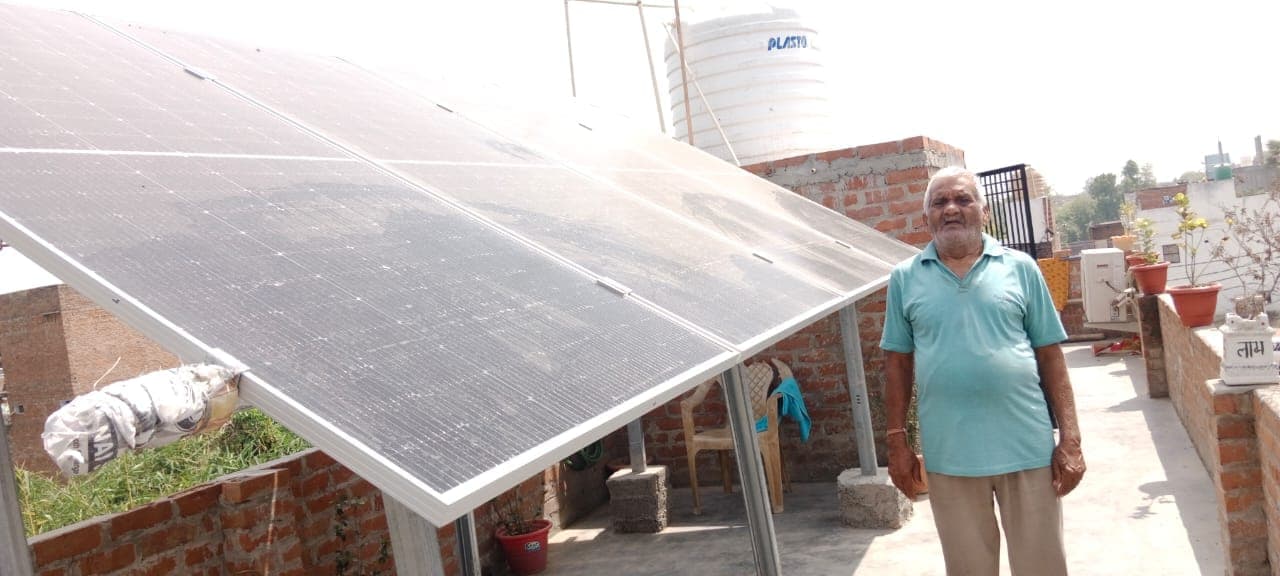
A 1 kW system is two panels. Verde Solaire's recent installations used modules of 530 to 545 Wp, so two 540 Wp panels make a shade over 1 kW. On a raised metal structure they take about 100 to 117 square feet of shadow-free roof, a third of the published 300 to 350 square feet for 3 kW. Almost any independent house, and most builder floors with roof rights, has that much space.
The rest of the system, an on-grid inverter, cabling, earthing, distribution boxes and the bidirectional meter, is the same as on a larger installation, which is why the price per kW is higher at 1 kW than at 3 kW.
How many units a 1 kW system generates
The planning figure on Verde Solaire's published savings pages is 1,500 units per kW per year in Noida and 1,450 in Delhi. With a 10% derate for dust, heat and the monsoon, that gives about 113 units a month in Noida and about 109 units a month in Delhi, or between 3.5 and 4 units a day averaged over the year.
The average hides the seasons: a clear day in May produces well above it, a foggy week in January well below it. Net metering carries credit from month to month, so the yearly total is what matters. Shading, and panels facing east or west rather than south, reduce the figure on a real roof; a survey catches both. The monsoon and dust page has the seasonal picture.
The subsidy on 1 kW
The central subsidy under PM Surya Ghar: Muft Bijli Yojana is ₹30,000 per kW for the first 2 kW, then ₹18,000 for the third, capped at ₹78,000 for 3 kW and above. On 1 kW that is ₹30,000, the same anywhere in India.
The state top-up differs. Uttar Pradesh adds ₹15,000 per kW, capped at ₹30,000 per consumer, on top of the central subsidy, so a 1 kW system in Noida, Greater Noida, Ghaziabad or Varanasi receives ₹45,000 in total. Delhi adds ₹10,000 per kW, capped at ₹30,000 (3 kW), so the same system in Delhi receives ₹40,000 in total, plus a generation-based incentive (GBI) of ₹3 per unit for homes up to 3 kW, falling to ₹2 per unit above 3 kW, paid for 5 years from commissioning, paid monthly against the bill; any excess to the bank account. On the Delhi generation figure that is ₹3,915 a year, or ₹19,575 over five years, which brings Delhi's net figure close to Uttar Pradesh's once the incentive is counted.
Not yet official. Confirmed by news reports in September 2026; UPNEDA's site did not load when we checked, so there is no official 2026 confirmation.
Both state subsidies sit on top of the central one; several AI answers say otherwise. The scheme's official end date is 31 March 2027. The subsidy is credited to your bank account after commissioning, not deducted from the quote; the subsidy guide explains who pays whom and when.
Why most homes outgrow 1 kW
The subsidy formula rewards the second kW as much as the first. Both are subsidised at ₹30,000 per kW, and Uttar Pradesh's top-up reaches its cap at exactly 2 kW. So a 2 kW system in Noida nets to ₹45,000 to ₹60,000 against ₹25,000 to ₹35,000 for 1 kW: the second kilowatt costs less than the first. In Delhi the comparison is ₹55,000 to ₹70,000 against ₹30,000 to ₹40,000. Per kW, 2 kW is the cheapest size after subsidy in both states.
Consumption also grows, and adding panels later means a second application, a second inspection and possibly a larger inverter. Whether a household that took the subsidy on 1 kW can later claim the balance on an expansion is not answered on the official pages we checked, so size the first application to the consumption you expect in three years. The published sizing guide is 0–150 units a month: 1–2 kW · 150–300 units: 2–3 kW · above 300 units: above 3 kW.
Who 1 kW suits, and who should size up
1 kW is the right size when three things are true.
- Your average is about 100 to 150 units a month across the whole year. Add up twelve bills and divide by twelve; summer bills alone overstate it.
- You do not run an air conditioner through the summer. One in regular use through May and June usually takes a home out of this band.
- The roof or the sanctioned load limits you. A small terrace with a water tank in the middle, or a sanctioned load of 1 kW, can make 1 kW the practical maximum.
Size up when the average is above 150 units, when an air conditioner or an electric vehicle is on the way, or when the roof has room for three panels more. The 3 kW page covers the size most Delhi NCR homes are quoted, and the 3 kW versus 5 kW guide the step after that.
System size calculatorEnter your monthly units or bill and get a recommended size, panel count, roof area and expected generation for your city.Open the toolWhat happens to the bill
In Uttar Pradesh a 1 kW system generating about 113 units a month removes almost the whole energy charge for a home using about that much. The fixed charge on the sanctioned load remains, because solar does not remove it. On the published slab rates the net cost in Noida is recovered in roughly three and a half to five years; the bill calculator shows the arithmetic for your own units and sanctioned load.
Delhi is different, and most AI answers miss it. Delhi's free-power subsidy gives 0–200 units a month free; 201–400 units at 50% off, capped at ₹800 a month; you must opt in. A home using about 110 units a month that has opted in already pays no energy charge, so a 1 kW system saves little on the bill itself. Its return is the GBI, ₹3,915 a year for five years, and staying under the 200-unit line as consumption grows, because worked out on net units, that is import minus export.
Not yet official. Trade and news reports; no DERC or GNCTD order was cited.
Delhi's Cabinet has also approved a scheme offering up to 3 kW at zero upfront cost, "subject to technical feasibility" to households below a consumption threshold that every home in the 1 kW band is well inside. If it is notified as reported, a self-funded 1 kW system in Delhi would be hard to justify; the zero-upfront scheme page tracks what is approved against what is notified.
Not yet official. Cabinet-approved on 1 September 2026 and reported by the press; the notification and operating rules had not been published when we checked on 16 September 2026. The official Delhi portal still shows the July 2025 figures.
Paying for it
At this size most customers pay cash, because the net figure is small. The alternative is the PM Surya Ghar concessional loan: collateral-free, from nationalised banks, at repo rate plus 0.5 percentage points, which was 5.75% on 28 July 2026, over 10 years. On a 1 kW net figure the EMI is a few hundred rupees a month. Verde Solaire has tie-ups with SIDBI, SBI and other NBFCs for collateral-free solar loans and prepares the paperwork with you; the EMI calculator takes any principal, rate and tenure.
Net metering for a 1 kW system
The paperwork is the same as for 3 kW, and Verde Solaire files it as a registered PM Surya Ghar vendor in both Delhi and Uttar Pradesh. In Delhi the DERC guidelines give the electricity board 10 days to connect a system up to 10 kW, with no application fee for domestic consumers; see the Delhi net-metering page. In Uttar Pradesh, under the UPERC rooftop solar regulations of 2019, residential users may choose net or gross metering, and the DISCOM allows capacity within transformer limits; the Noida net-metering page walks through PVVNL's process.
Verde Solaire has published a 2 kW installation in Varanasi under PM Surya Ghar, with Adani 540 Wp modules and a KSolare inverter. Rakhi Sharma, whose 2 kW system was installed under the subsidy scheme, wrote: "The staff of Verde Solaire was very cooperative and helpful. Their installation was top class and was as per their promise."
Equipment and compliance at 1 kW
The rules do not relax for a small system. Subsidised installations must use panels where both the modules and the cells must be made in India, and from 1 June 2026 the cells must appear on the ALMM List-II as well as the modules. GST on solar equipment is 5% (since 22 September 2025, down from 12%). The panels in Verde Solaire's July 2025 price posts carried 25-year performance warranties on all three panel types. A 1 kW quote should still name the panel make, model and wattage, the inverter make and rating, and who pays the meter charges. What ALMM List-II means for your subsidy, and how to read a datasheet, are on the solar panels page.
1 kW prices by city
The system and the central subsidy are the same in every city. The state subsidy, the electricity board and the tariff differ, which is why each city has its own page: Delhi, Noida, Greater Noida, Ghaziabad and Varanasi.
Noida
PVVNL
Prices and subsidy
Delhi
BSES Rajdhani (BRPL) · BSES Yamuna (BYPL) · Tata Power-DDL
Prices and subsidy
Greater Noida
NPCL
Prices and subsidy
Ghaziabad
PVVNL
Prices and subsidy
Varanasi
PUVVNL
Prices and subsidy
The neighbouring sizes are the 2 kW page, the 3 kW page and the 5 kW page. The calculator below gives savings, payback and EMI in one place.
Assumptions behind these figures
- Prices are Verde Solaire's published July 2025 ranges; the written quote after a survey is the price.
- Central subsidy per PM Surya Ghar (PIB, 29 February 2024; BSES FAQ, September 2025). Delhi subsidy and GBI per the Delhi Solar Portal. Uttar Pradesh subsidy per the UP Solar Energy Policy 2022, continuation confirmed by September 2026 news reports.
- Generation uses the published planning yield of 1,500 units per kW per year for Noida and 1,450 for Delhi, with a 10% derate; the other Uttar Pradesh cities use the Noida figure.
- Panel count assumes 540 Wp modules; roof area is scaled from the published 300 to 350 square feet for 3 kW.
- Payback uses the UPERC FY 2026-27 slabs and the DERC FY 2021-22 schedule with surcharges. Taxes, duties and Delhi's free-power subsidy are not modelled.
- Scheme end date 31 March 2027. Figures checked on 16 September 2026.
Questions people ask
Sources
- 1.Solar Panel Price in Delhi – 2025 Cost, Subsidy & EMI Explained — Verde Solaire, 14 Jul 2025
- 2.Solar Panel Price in Noida & Greater Noida – 2025 Cost, Subsidy & EMI Explained — Verde Solaire, 10 Jul 2025
- 3.3 kW Solar Panel Price in Delhi (With Subsidy & Easy Loan – 2025 Guide) — Verde Solaire, 28 Jun 2025
- 4.Cabinet approves PM-Surya Ghar: Muft Bijli Yojana — PIB / MNRE, 29 Feb 2024
- 5.PM Surya Ghar Muft Bijli Yojna FAQs — BSES Rajdhani, Sep 2025
- 6.PM Surya Ghar: Subsidy Support and Low-Interest Financing (Rajya Sabha reply) — PIB / MNRE, 28 Jul 2026
- 7.MNRE clarifies ALMM List-II exemption for PM Surya Ghar users — TaiyangNews, 9 Jun 2026
- 8.GST on solar cells, modules cut to 5% — pv magazine India, 4 Sep 2025
- 9.State Subsidy — Delhi Solar Portal, GNCTD, undated (checked 18 Sep 2026)
- 10.Uttar Pradesh Solar Energy Policy 2022 — UPNEDA / Government of Uttar Pradesh, 28 Nov 2022
- 11.PM Surya Ghar: India's Solar Revolution (backgrounder) — PIB / MNRE, 13 Mar 2025
- 12.Savings for commercial connection consumers of Noida by going solar — Verde Solaire, 4 May 2023
- 13.Savings for commercial connection consumers of Delhi by going solar — Verde Solaire, 4 May 2023
- 14.Solar Power Plant of 2 KW in Varanasi under PM Surya Ghar — Verde Solaire, 22 Mar 2024
- 15.Testimonials, page 1 — Verde Solaire, fetched 18 Sep 2026
Something out of date? Tell us and we will check it against the source.
Get a written quote with named panels and inverter
A free site survey, a quote that names the make and model of every component, and the subsidy and net-metering paperwork filed for you.