Guide
Solar panel maintenance and cleaning in NCR
Figures verified on 18 Sept 2026; next review 18 Dec 2026. Every number links to its source on the sources page.
A rooftop solar system in Delhi NCR needs two things from its owner: plain water on the glass every few weeks in the dry months, and one proper check a year of the connections, earthing, inverter and structure. There is nothing to oil and nothing to replace on a schedule, and the panels Verde Solaire sells carry 25-year performance warranties on all three panel types, as published in its July 2025 price posts. [vs-post-143]
This page exists because dust is the one running cost a payback calculation has to carry. Every calculator on this site takes 10% off the published generation figure for soiling and season. That is a planning assumption, not a measurement of any particular roof, and the point of cleaning is to keep the real loss below it.
What NCR dust does to output
A panel makes electricity from the light that reaches its cells. A film of dust scatters and absorbs part of that light before it gets there, so the loss grows a little every dry day after the last wash and disappears with the next one. Two stretches of the year are the worst in Delhi NCR: October and November, when the air is still, there is no rain and the smog settles on every surface; and April to June, when the hot wind brings dust storms. In the monsoon, from late June to September, the rain does most of the washing, but it leaves streaks where the water dries and does nothing for bird droppings.
Bird droppings are the one thing to deal with the same week. A dropping shades a single cell, the shaded cell resists the current of the whole string, and it heats up. Cleaned promptly, nothing happens. Left for a season, it can mark the cell.
You can see the effect without instruments. Note the generation on a clear day from the inverter display or the app, wash the panels, and compare the next clear day. If the wash recovers a noticeable amount, you waited too long. The monsoon and dust guide goes month by month through what to expect.
How often to clean
No policy document sets a frequency; what follows is a working routine for Delhi NCR, not a published fact. Rinse every two to three weeks from October to June, and always in the week after a dust storm. Leave the monsoon largely to the rain, and rinse once at its end to take the streaks off. Wipe bird droppings as soon as you see them. A house beside a construction site, a busy road or open farmland needs the shorter interval; a roof well above the traffic can stretch it.
How to clean safely
Clean early in the morning or after sunset, when the glass is cool and the system is making little or nothing. Cold water on hot glass stresses it, and a panel at midday in May is hot enough to matter.
- Use plain water from a hose or a bucket. Low pressure is enough. A pressure washer can force water past the frame seals and is the first thing a manufacturer's care sheet rules out.
- Loosen dirt with a soft sponge, a microfibre cloth or a long-handled soft brush. No detergent, no scouring pad, no metal, and no scraping at a dried dropping: soak it and wipe.
- Hard water leaves mineral marks when it dries. Rinse, then pull a squeegee or a clean cloth across the glass while it is still wet.
- Never stand, kneel or lean on a panel, and never step on the frames. Reach from the walkway, the terrace floor or a stable ladder placed on the roof, not on the array.
- Do not pull on cables or connectors. If you find cracked glass, a chewed cable, a loose connector or a burn mark, stop and call the installer. Those are not cleaning jobs.
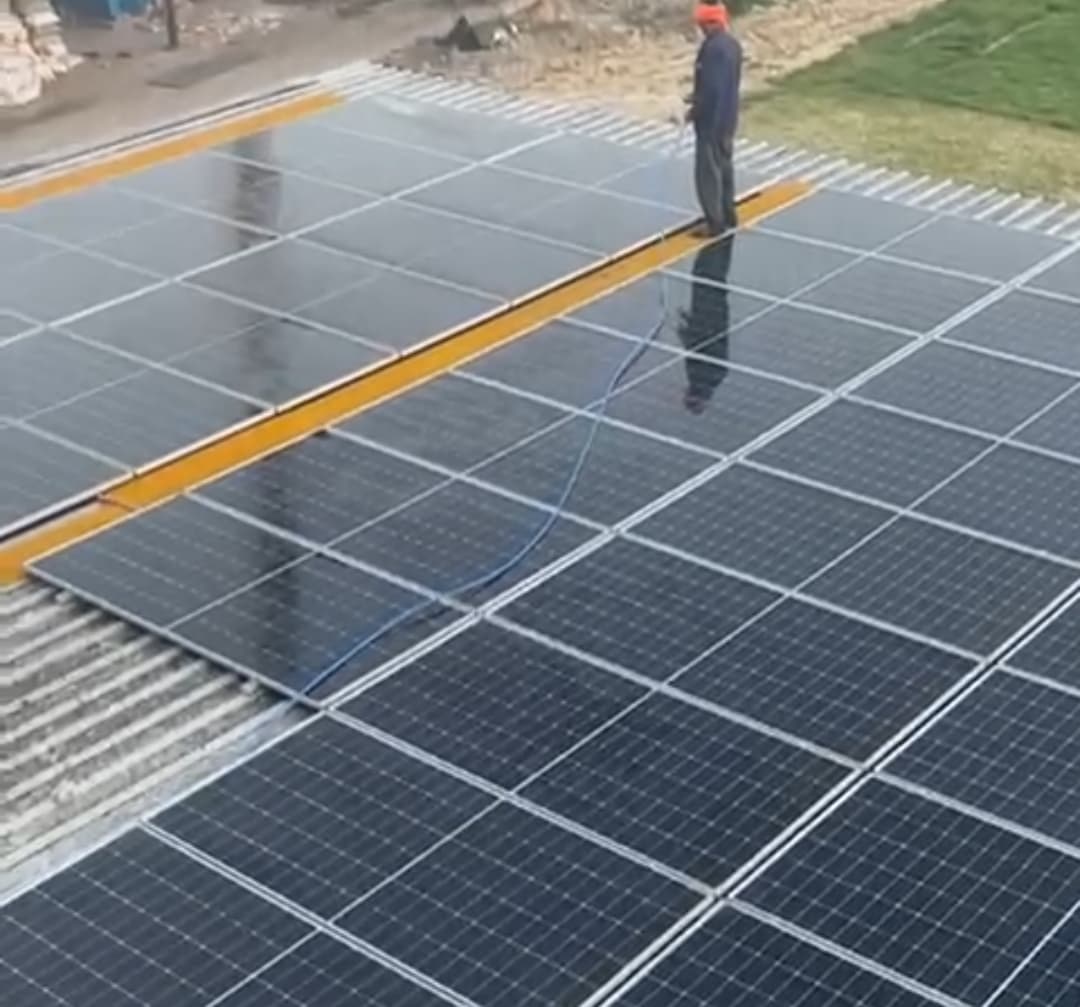
Call a professional when the array is out of easy reach. Many Delhi NCR homes mount the panels on a raised steel structure above the terrace so the roof stays usable, which puts the glass above head height and the far rows beyond arm's reach. Sloped roofs, tin sheds and anything you would have to climb onto belong to someone with a harness. So do pigeon nests under the panels, which return unless the gap is closed with mesh, and larger plants: Verde Solaire's 430 kW factory plant at Dharuhera was built with walkways and a module cleaning system for exactly this reason. [vs-post-13] The maintenance and cleaning service page describes what Verde Solaire offers for homes and businesses.
The annual check
Cleaning keeps the light coming in. The annual check keeps the electricity going out, and it is the part owners skip because nothing looks wrong. Have it done once a year, ideally in September or October after the monsoon and before the dry season, and ask for a short written report. It should cover:
- DC and AC connections. Every connector and terminal in the DC box, the AC box and the inverter is checked for tightness, and the boxes are inspected for discolouration, burn marks or water. A loose DC connector is the most common cause of a fault after installation.
- Earthing. The earth continuity of the structure and the inverter is measured and the earth pit is checked. Lightning arrestors, where fitted, are inspected.
- Inverter. The fault log is read, the vents and fan are cleared of dust, the firmware is updated where the maker has released one, and the year's generation is compared with what a system of that size should have produced. The solar calculator gives the figure to compare against.
- Structure and fixings. Bolts, clamps and the fixing of the modules to the rails are checked, rust on the structure is treated, and the sealant at every roof penetration is inspected so the terrace does not leak in July.
- Cables. Insulation is checked for sun damage and rodent bites, and cable ties and conduits that have worked loose are refitted.
- Under the panels. Nests, droppings, leaves and anything else that has collected between the panels and the roof are cleared, and any gap the birds are using is closed.
- The meter. The net-meter readings are compared with the inverter's generation log, so that a metering problem shows up as a mismatch rather than as a larger bill.
Delhi's new zero-upfront scheme is reported to include free operation and maintenance for 5 years for the households it covers. For everyone else, maintenance is either included in the installer's quote for a stated number of years or bought separately. Ask which, and get the years in writing.
Not yet official. Cabinet-approved on 1 September 2026 and reported by the press; the notification and operating rules had not been published when we checked on 16 September 2026. The official Delhi portal still shows the July 2025 figures.
Warranties: what is written down
The warranty that matters most is the one on the panels, because they are most of the cost and all of the generation. Verde Solaire's July 2025 price posts state 25-year performance warranties on all three panel types: mono PERC, bifacial and TOPCon. [vs-post-142] A performance warranty is a promise about output: the manufacturer guarantees that the panel will still produce at least a stated share of its rated power at year 25. It is separate from the product warranty against defects in the glass, frame and junction box, which is usually shorter, and a quote should state both.
Inverter warranties vary by make and model, and the inverter is the component most likely to be replaced once in the life of the panels. The one figure Verde Solaire has published is for a commercial plant: the Havells inverters on the 430 kW Dharuhera installation carried a 10-year warranty. [vs-post-13] Ask for the make, the model and the warranty years of the inverter in your own quote; the inverter guide explains what to look for.
Verde Solaire has not published a workmanship warranty period or the number of years of maintenance included with a home installation, so this page does not state one. Ask for both in writing before you pay an advance; the warranty and after-sales page and the advance checklist list the questions to put.
Cleaning with water and soft tools does not affect any of these warranties. Abrasives, detergents and pressure washers can, because the manufacturer's care instructions exclude them.
How long the panels last
The performance warranty runs 25 years, and the panels do not stop at the end of it; they keep generating at a lower output. The 25-year projections on this site assume that output falls by 0.7% a year, which is a planning assumption rather than a measurement, and on that assumption a panel is still producing more than four-fifths of its first-year output in year 25.
What that looks like on a roof: Mr. S. C. Garg installed his system at his home in GK, New Delhi, when the company still traded as Sirius Electric, and wrote on Verde Solaire's testimonials page that "the solar system has been working continuously without a single day breakdown since 2017" and that "The solar plant installed at my place is maintenance free". [vs-testimonials-1] One customer's experience is not a guarantee, and his panels will still have needed washing. It is, though, what a well-installed system looks like nine years on.
Sources and dates
The panel warranty is as Verde Solaire published it in July 2025; the Dharuhera plant details are from its post of 30 March 2023; the customer quote is from its testimonials page, fetched 18 September 2026. The Delhi scheme's maintenance term is reported by the press after the 1 September 2026 Cabinet decision and had not been notified when we checked. The cleaning routine and the annual checklist are this guide's recommendations, not published facts, and the 10% soiling derate and the 0.7% yearly degradation are the planning assumptions used by this site's calculators, shown under every result. For the payback question these numbers feed, see is rooftop solar worth it in Delhi NCR and common problems after installation.
Questions people ask
Sources
- 1.Solar Panel Price in Delhi – 2025 Cost, Subsidy & EMI Explained — Verde Solaire, 14 Jul 2025
- 2.Solar Panel Price in Noida & Greater Noida – 2025 Cost, Subsidy & EMI Explained — Verde Solaire, 10 Jul 2025
- 3.Testimonials, page 1 — Verde Solaire, fetched 18 Sep 2026
- 4.430 KW solar power plant at Dharuhera (Adani panels, Havells inverters) — Verde Solaire, 30 Mar 2023
- 5.Delhi: Solar policy gets major push, 2.30 lakh rooftops targeted by March 2027 — ANI, 1 Sep 2026
- 6.Delhi govt to give free solar panels to 2.3 lakh households — India TV, 1 Sep 2026
Something out of date? Tell us and we will check it against the source.
Get a written quote with named panels and inverter
A free site survey, a quote that names the make and model of every component, and the subsidy and net-metering paperwork filed for you.