Noida · 3 kW
3 kW solar panel price in Noida 2026
Figures verified on 16 Sept 2026; next review 16 Dec 2026. Every number links to its source on the sources page.
A 3 kW rooftop solar system in Noida costs ₹1,99,000 to ₹2,10,000 on Verde Solaire's published price list of July 2025, and ₹91,000 to ₹1,02,000 once the ₹78,000 central subsidy and the ₹30,000 Uttar Pradesh subsidy have been paid into your bank account. The two together come to ₹1,08,000, a little over half the published price. The subsidy figures were checked against the scheme documents on 16 September 2026.
This page covers one size in one city. The Noida price page has every size from 1 to 10 kW, and the 3 kW page compares the same system across the five cities Verde Solaire serves.
What the published price includes
The range of ₹1,99,000 to ₹2,10,000 covers panels, inverter, mounting structure, net metering, installation and warranty. [vs-post-142] It is a range rather than a single figure because roofs differ: a raised structure that keeps the terrace usable underneath takes more steel than a low-tilt frame. The written quote after a site survey is the price.
For planning we assume 540 Wp modules, which makes a 3 kW system six panels; the quote names the actual module. For a subsidised system, both the modules and the cells must be made in India, and from 1 June 2026 the cells must also appear on ALMM List-II, the approved list of cell makers. [27] Verde Solaire's published home installations in Delhi NCR have used Adani and Vikram modules with KSolare inverters, and the July 2025 price posts state 25-year performance warranties on all three panel types. Ask for the inverter and workmanship warranty in writing as well.
GST on solar cells and modules is 5% (since 22 September 2025, down from 12%); a quote or an online estimate built on the older rate is out of date. [29]
The subsidy split for 3 kW in Noida
The central PM Surya Ghar: Muft Bijli Yojana subsidy is ₹30,000 per kW for the first 2 kW and ₹18,000 for the third, which is how a 3 kW system reaches the cap of ₹78,000. [1] The formula behind those figures is 60% of the benchmark cost for the first 2 kW and 40% for the part between 2 and 3 kW, capped at 3 kW.
Uttar Pradesh adds ₹15,000 per kW under the state's Solar Energy Policy 2022, capped at ₹30,000 per consumer, on top of the central subsidy. [16] News reports in September 2026 describe combined central-plus-state totals of ₹45,000, ₹90,000 and ₹1.08 lakh for 1, 2 and 3 kW, paid by direct bank transfer 30–45 days after verification. [18]
| System size | Central (PM Surya Ghar) | Uttar Pradesh state subsidy | Total subsidy |
|---|---|---|---|
| 1 kW | ₹30,000 | ₹15,000 | ₹45,000 |
| 2 kW | ₹60,000 | ₹30,000 | ₹90,000 |
| 3 kW | ₹78,000 | ₹30,000 | ₹1,08,000 |
| 5 kW | ₹78,000 | ₹30,000 | ₹1,08,000 |
Not yet official. Confirmed by news reports in September 2026; UPNEDA's site did not load when we checked, so there is no official 2026 confirmation.
Both amounts go to you, not to the installer, after the board has inspected the system and the commissioning certificate is on the portal. Officially the central subsidy is paid "within 30 days" of the claim; about 15 days on average. Until it lands, you or your lender carry the full published price.
Two things about this size that trip people up in Noida
The state cap is reached at 2 kW
Because the Uttar Pradesh subsidy is ₹15,000 per kW with a ceiling of ₹30,000 per consumer, on top of the central subsidy, the ceiling is hit at 2 kW. The third kilowatt brings in ₹18,000 from the centre and nothing from the state. Compare the published prices for 2 kW, ₹1,35,000 to ₹1,50,000, and for 3 kW, ₹1,99,000 to ₹2,10,000: most of that step is paid by you. Size to twelve months of bills, not to the subsidy table. The published sizing guide is 0–150 units a month: 1–2 kW · 150–300 units: 2–3 kW · above 300 units: above 3 kW, and Verde Solaire's own post pitches 3 kW at homes using 200 to 400 units a month with two to four air conditioners. [vs-post-139]
Noida city is PVVNL, not NPCL
Noida city's electricity distributor is PVVNL (Paschimanchal Vidyut Vitran Nigam Limited, a UPPCL company). NPCL (Noida Power Company Limited) serves Greater Noida and Greater Noida West. They are different companies, and the feasibility approval, the inspection and the net meter all come from whichever one prints your bill.
Not yet official. From a secondary source; confirm against your electricity bill.
The point needs stating because the AI-answer audit Verde Solaire commissioned in September 2026 found 23 answers naming NPCL as Noida city's distributor. [study-2026-09] Verde Solaire's head office is in Sector 47, Noida, inside the city that PVVNL serves.
Roof and panels: what 3 kW needs
Verde Solaire's published figure is 300 to 350 square feet of shadow-free roof for 3 kW. [vs-post-139] Shadow-free is the part that matters. Six panels are usually wired as one string into the inverter, so a water tank, a lift room or a neighbour's parapet that shades one panel in the afternoon pulls down all six for that hour.
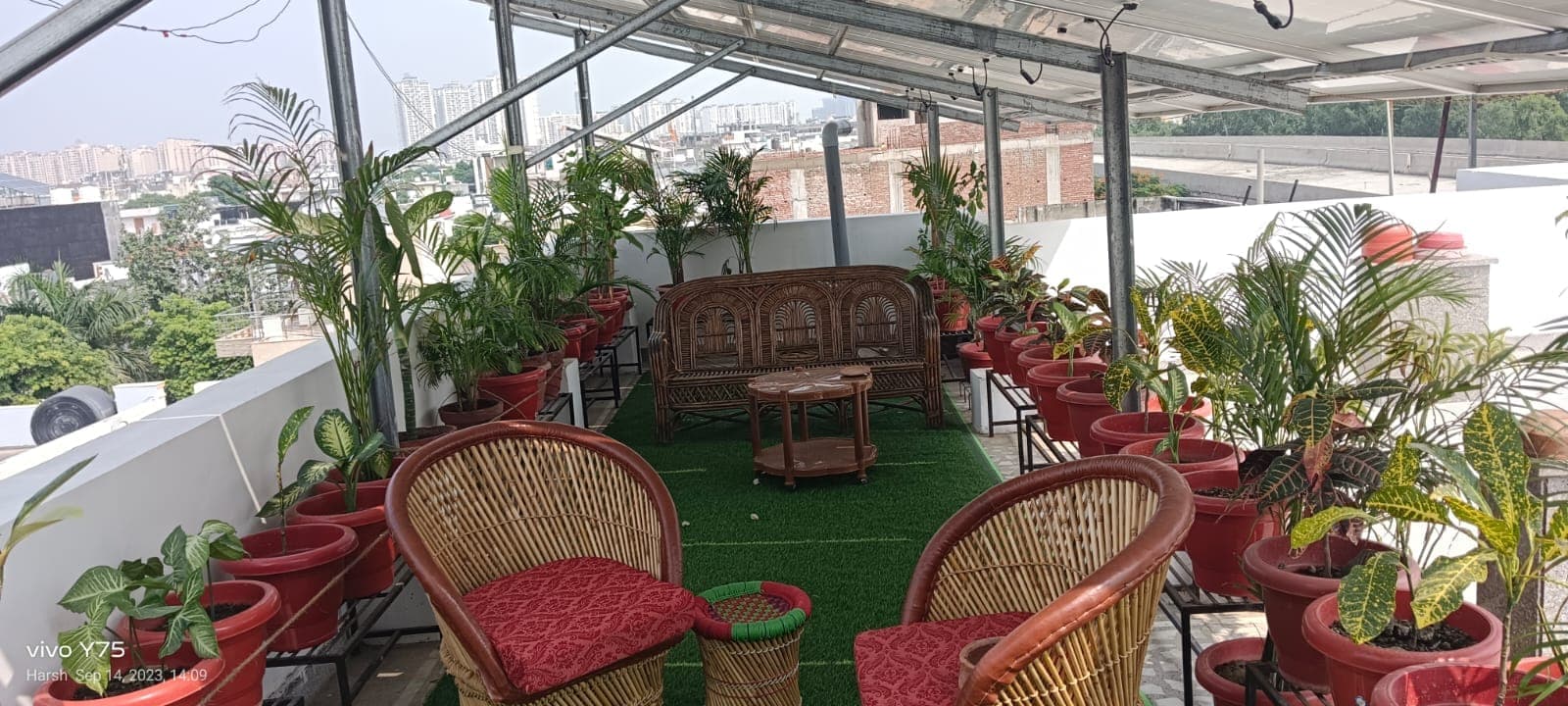
On an independent house the roof is yours. On a builder floor the roof right in the sale deed, the other floors' consent and the sanctioned load on your own connection decide whether 3 kW is possible, so bring those papers to the survey.
Units a month, and what the electricity bill does
Verde Solaire's published planning figure for 3 kW in Noida is 360 to 400 units a month. [vs-post-139] The calculator at the foot of this page is more cautious: it removes 10% from the published yield for dust and monsoon, an editorial assumption, and shows about 338 units a month. Budget on the lower number.
Uttar Pradesh urban domestic tariffs for FY 2026-27 are ₹5.50 (0–150 units), ₹6.00 (151–300), ₹6.50 (301–500) and ₹7.00 (above 500) per unit, plus a fixed charge of ₹110 per kW per month. [21]
Not yet official. Taken from secondary summaries of the FY 2026-27 UPERC order; the order itself was not fetched.
A home using 350 units a month sits in the third slab. A 3 kW system producing a little under that removes most of the energy charge; what remains is the fixed charge on your sanctioned load plus whatever the system did not cover in a cloudy month. The bill after solar is small, not nil, and the fixed charge is billed whether or not the sun shines.
Bill calculator for PVVNLEnter your units and sanctioned load to see the bill before and after 3 kW on the FY 2026-27 slabs.Open the toolSanctioned load and the connection
Your sanctioned load is printed on the bill in kW. On the regulatory side, under the UPERC rooftop solar regulations of 2019, residential users may choose net or gross metering, and the DISCOM allows capacity within transformer limits. [20] The connection feeds two separate decisions: the board's feasibility check, which looks at your sanctioned load and the local transformer, and the fixed charge, billed per kW of sanctioned load at ₹110 per kW per month. If your sanctioned load is below 3 kW, raise it with the engineer at the survey.
Surplus units exported in a sunny month are credited against later consumption. For what is left over, UPERC set a compensation rate of the weighted-average large-solar tariff plus 25% (Third Amendment, in force from July 2025).
Not yet official. Read through a secondary summary; the gazette text was not checked.
The PVVNL process, step by step
- Register on pmsuryaghar.gov.in with Uttar Pradesh, PVVNL, your consumer number and mobile number.
- Apply for rooftop solar and choose the vendor: the installer must be a vendor registered on the national portal, and you choose the vendor on pmsuryaghar.gov.in. Verde Solaire is a registered PM Surya Ghar vendor in both Delhi and Uttar Pradesh.
- Wait for PVVNL's feasibility approval.
- Installation.
- Submit the plant details and apply for the net meter.
- PVVNL inspects the installation.
- The commissioning certificate is issued on the portal.
- Submit bank details and a cancelled cheque.
- The subsidy is credited: officially "within 30 days" of the claim; about 15 days on average; reported as 30–45 days after verification in practice.
Not yet official. Reported by trade and news sources; the official figure is within 30 days.
Verde Solaire files the application, attends the inspection and follows the net meter through to activation. Brij Lal Bhardwaj, who installed 4 kW at his Sector 25 home, wrote that the team handled the paperwork and the liaison with the electricity board for the net meter, and had his subsidy processed. Mr. L. R. Singh, on a 6 kW system, wrote: "I was also able to get solar subsidy in record time because of the follow up of the team of Verde Solaire". The stage-by-stage timeline is on the Noida net-metering page.
Paying for it: loan or cash
The PM Surya Ghar concessional loan is collateral-free, from nationalised banks, at repo rate plus 0.5 percentage points, which was 5.75% on 28 July 2026, over 10 years. [3] Verde Solaire has tie-ups with SIDBI, SBI and other NBFCs for collateral-free solar loans and prepares the application with you. Because the subsidy arrives after commissioning, the loan bridges the gap between the published price and the net figure, then spreads the net cost over the tenure.
EMI on the 3 kW net priceAny rate and tenure; the default is the PM Surya Ghar loan on the Noida net price.Open the tool3 kW or 5 kW in Noida?
At 5 kW the subsidy is the same rupee total, ₹78,000 central plus ₹30,000 per consumer, on top of the central subsidy state, against a published price of ₹3,25,000 to ₹3,50,000, so the net cost of ₹2,17,000 to ₹2,42,000 is higher per kilowatt. Scaling the published 3 kW figure, it needs roughly 500 to 580 square feet of roof, and a sanctioned load to match. If twelve months of bills average above about 400 units, read the 5 kW page for Noida first; below that, 3 kW lets the subsidy do the most work.
What AI answers get wrong about this price
The September 2026 audit put this exact question to four AI engines from Noida, twice each; Google showed no AI Overview for it. [study-2026-09] Every answer used a gross range wider than the published list, starting below it and running above it, so their net figures spread further than a written quote would. One engine deducted only the central subsidy and treated the Uttar Pradesh top-up as something that varies by eligibility, which leaves its net figure a whole state subsidy too high. Across the wider audit, 23 answers put Noida city under NPCL, 32 quoted a loan rate above the current 5.75%, five used the GST rate replaced in September 2025, and four gave the scheme's end date as 2026 when it is 31 March 2027. Every figure here is dated and sourced; the full list is on what AI answers get wrong.
Sources and dates
- Price: Verde Solaire's posts of 28 June 2025 [vs-post-139] and 10 July 2025 [vs-post-142]; the written quote after a survey is the price.
- Central subsidy: Cabinet approval of 29 February 2024 [1] and the BSES Rajdhani FAQ of September 2025 [4].
- Uttar Pradesh subsidy: UP Solar Energy Policy 2022 [16] and the UPNEDA brochure of 21 February 2024 [17]; continuation reported on 9 September 2026 [18].
- Loan: Rajya Sabha reply of 28 July 2026 [3]. ALMM List-II: MNRE clarification of June 2026 [27]. GST: [29].
- Net metering and tariffs: secondary summaries of the UPERC third amendment [20] and the FY 2026-27 order [21] [22]. Distributor boundaries: [22]; confirm against your bill.
- Generation: the published planning yield for Noida with a 10% derate for dust and monsoon, an editorial assumption.
- Scheme end date: 31 March 2027.
- AI-answer audit: 98 prompts across five engines, collected 16 and 17 September 2026 [study-2026-09].
Questions people ask
Sources
- 1.Solar Panel Price in Noida & Greater Noida – 2025 Cost, Subsidy & EMI Explained — Verde Solaire, 10 Jul 2025
- 2.3 kW Solar Panel Price in Noida (With Subsidy & Easy Loan) — Verde Solaire, 28 Jun 2025
- 3.Cabinet approves PM-Surya Ghar: Muft Bijli Yojana — PIB / MNRE, 29 Feb 2024
- 4.PM Surya Ghar Muft Bijli Yojna FAQs — BSES Rajdhani, Sep 2025
- 5.PM Surya Ghar: Subsidy Support and Low-Interest Financing (Rajya Sabha reply) — PIB / MNRE, 28 Jul 2026
- 6.MNRE clarifies ALMM List-II exemption for PM Surya Ghar users — TaiyangNews, 9 Jun 2026
- 7.GST on solar cells, modules cut to 5% — pv magazine India, 4 Sep 2025
- 8.Uttar Pradesh Solar Energy Policy 2022 — UPNEDA / Government of Uttar Pradesh, 28 Nov 2022
- 9.PM Surya Ghar Yojana: solar panel subsidy up to Rs 1.08 lakh in UP — Business Today Bazaar, 9 Sep 2026
- 10.UPERC (Rooftop Solar PV Grid Interactive Systems) Regulations, 2019, Third Amendment (summary) — TeamLease RegTech, amendment issued 3 Jun 2025
- 11.PM Surya Ghar: India's Solar Revolution (backgrounder) — PIB / MNRE, 13 Mar 2025
- 12.Grid-Connected Rooftop Solar System for Residential Consumers (brochure) — UPNEDA, 21 Feb 2024
- 13.UPERC retains FY27 power tariffs, raises subsidy and expands EV benefits — Power Peak Digest, 2026
- 14.Electricity rate per unit in Noida & Greater Noida (2026) — noidarent.com, updated Jul 2026
- 15.Testimonials, page 1 — Verde Solaire, fetched 18 Sep 2026
- 16.Testimonials, page 2 — Verde Solaire, fetched 18 Sep 2026
- 17.Verde Solaire: SEO & AEO Strategy (directory listings and credentials compiled from Justdial, IndiaMART and government registries) — Millennial AI, 12 Sep 2026
Something out of date? Tell us and we will check it against the source.
Get a written quote with named panels and inverter
A free site survey, a quote that names the make and model of every component, and the subsidy and net-metering paperwork filed for you.