
Marwar Carpets, Panipat: 110 kW rooftop
Verde Solaire installed a 110 kW grid-connected rooftop solar plant at the Marwar Carpets factory in Panipat, Haryana. The company's published case study lists 334 Vikram polycrystalline modules of 330 Wp each and Schneider string inverters on 10,500 sq ft of roof, an annual yield of 159,417 units, and a saving of about ₹7.85 for every unit generated.
That is the project in one paragraph. The rest of this page gives the published specification, what the plant did for the factory's bills during and after the Covid shutdown, and what its owner wrote afterwards.
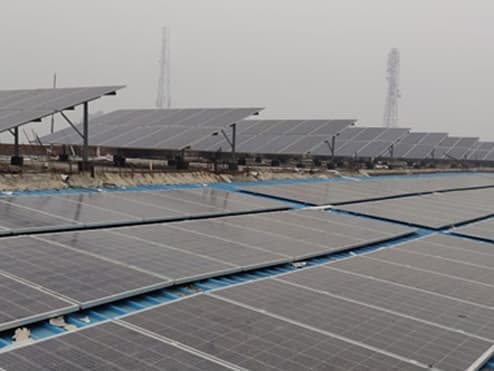
The system as published
| Item | Published figure |
|---|---|
| Owner | Marwar Carpets |
| Location | Panipat, Haryana |
| Connection type | Grid-connected |
| Rated system power | 110 kW |
| Modules | 334 × 330 Wp polycrystalline, Vikram Solar |
| Inverters | Schneider grid-connected string inverters |
| Roof area used | 10,500 sq ft |
| Annual energy yield | 159,417 kWh a year |
| Carbon dioxide avoided | about 160.6 tonnes a year |
| Design life | 25 years |
Two figures follow from that table by arithmetic. The yield works out to about 1,450 units per kW a year, which is close to the planning figure Verde Solaire uses on its commercial savings pages for Delhi NCR. The roof takes about 95 sq ft per kW, because 330 Wp modules were the standard when this plant was built; Verde Solaire's recent Noida and Delhi installations used 530 to 545 Wp modules, so the same capacity now needs a smaller roof.
What it does for the electricity bill
The case study puts the saving at about ₹7.85 for each unit the plant generates, and notes that the figure rises every time the tariff does. Multiplying the two published numbers, 159,417 units at that rate, gives about ₹12.51 lakh a year. That is an arithmetic result, not a published one: the real total depends on the tariff category on the factory's connection and on how much of the generation is used on site. Verde Solaire has not published a before-and-after bill for Marwar Carpets, so this page does not quote one.
The plant kept working when the factory did not. During the Covid shutdown, the case study says, the units it produced were exported to the grid, so the owner benefited while production was stopped. That is the practical argument for a grid-connected plant on a factory roof: generation does not depend on the machines running that day.
What the owner said
Nikunj Aggarwal, the owner, wrote on Verde Solaire's testimonials page: "The company completed the work in record time with high quality solar panels from Vikram and solar inverters from Schneider. The savings in electricity bill is huge from this solar plant installation at my Panipat factory."
He also explained how the order came about. Verde Solaire had earlier installed a 20 kW plant at his home in New Delhi, and he placed the factory order once the bills at his residence started coming down. His review ends: "Verde Solaire is highly recommended as a solar power installation company for high quality and timely work."
What this means for a factory in Delhi NCR
Panipat is in the Haryana part of the National Capital Region. Verde Solaire is certified by Vikram Solar as a trusted quality EPC integrator, which is the module brand on this roof, and it is registered with IOCL, UHBVN, DHBVN, CEL, IPGCL, BRPL and CREST for solar power plant installations; UHBVN and DHBVN are the two distribution licensees in Haryana. The company has delivered more than 50 MW of solar projects in total.
The closest published comparison is the 200 kW plant at Jama Corporation, Kanpur, from the same case study, which uses a zero-export device instead of grid export. The commercial and industrial page sets out how a factory plant is sized and financed, and the commercial payback calculator applies your own tariff and load. All published projects are listed on the projects page, and other customer reviews on the reviews page.
Questions people ask
Start with a clear plan for your savings
Get a free roof assessment and a written quote for branded equipment. We will also explain the loan, installation, net-metering and subsidy steps.