
Ground-mounted solar plants on open land
A ground-mounted solar plant is the right choice when you have open land and the roof cannot do the job: it is too small, cannot carry a structure, is shaded, or faces the wrong way. Verde Solaire lists ground-mounted grid-connected plants as a product, carries the civil foundations, galvanised iron structure, DC and AC wiring, earthing and commissioning in its own scope, and has delivered more than 50 MW of solar projects with a team with combined experience of more than 2,000 MW.
This page explains when the ground beats the roof, what a plant on land needs, what Verde Solaire's scope covers, and which panels suit an open site. There is no published per-kW price for ground-mounted work; every plant is quoted after a free site evaluation and no-obligation proposal.
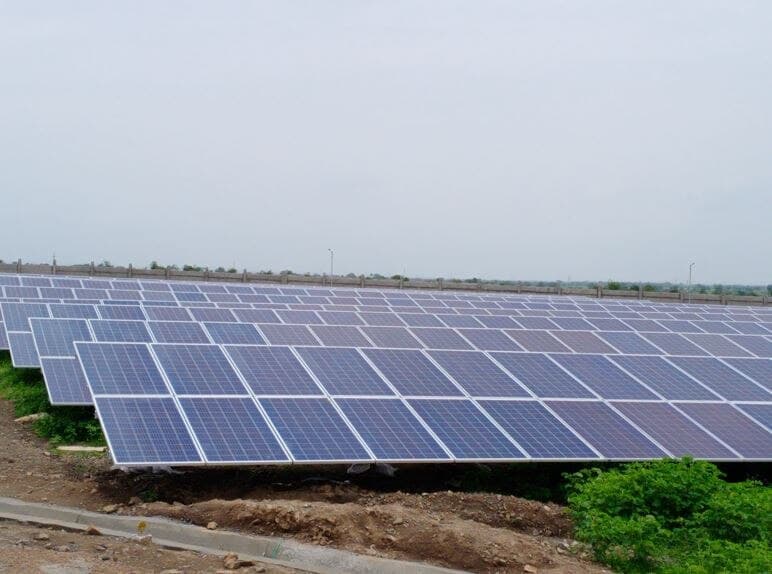
When ground mount beats rooftop
Four things change when the array leaves the roof.
Tilt and orientation are yours to set. On a roof the structure follows the roof: a sloping tin shed fixes the tilt, a parapet or water tank fixes where the rows can go, and a north-facing slope costs output all year. On the ground the rows face south at the tilt the site's latitude favours, and the gap between rows is chosen so that the low winter sun does not throw one row's shadow onto the next. Verde Solaire's product page gives this freedom as the reason a ground-mounted plant produces more units than a rooftop plant receiving the same sunlight.
Cleaning is done standing up. Dust is the main loss on any plant in north India, and on a roof every wash means a ladder and someone walking on a sheet roof. On the ground the panels are at waist to shoulder height, with a walkway between rows and a water line along the array. The maintenance and cleaning page covers the schedule; the dust and monsoon page covers what dust costs.
Nothing rests on the building. A roof structure adds load to the slab or the purlins, which on an old building means a structural check, and it means holes through the waterproofing or ballast to avoid them. A ground-mounted plant needs neither.
The size follows the land, not the roof. On land the limit is the plot, the sanctioned load on the connection and what the electricity board's transformer can take, which is usually a larger number.
Rooftop still wins in two cases. The first is land with a better use, since a plant occupies its plot for the life of the panels. The second is a small home system, because the central subsidy under PM Surya Ghar: Muft Bijli Yojana is written for an Indian citizen who owns a house with a suitable roof, has a valid electricity connection and has not taken an earlier solar subsidy, which points at a roof.
What a ground-mounted plant needs
Land. Verde Solaire's rooftop planning figure is 300 to 350 square feet of shadow-free area for 3 kW. On the ground the same capacity needs more, because row spacing, a cable trench, an inverter room and cleaning access all take area a roof does not need. Treat the rooftop figure as the floor; the survey fixes the number for your plot.
Foundations. The galvanised iron structure stands on concrete footings, one per column, designed after a look at the soil. Loose fill, black cotton soil and a high water table each change the footing, which is why civil work is a separate line in Verde Solaire's scope.
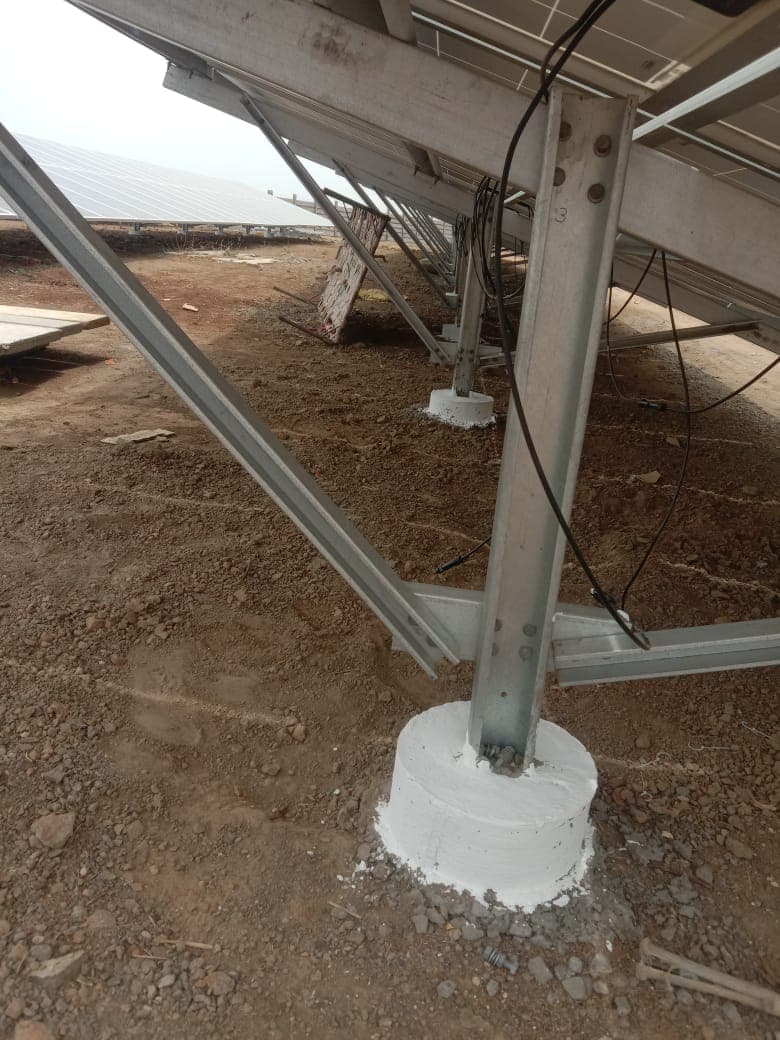
The cabling run. On a roof the inverter sits a few metres from the array. On land the array may be a hundred metres or more from the inverter room and further from the metering point. That distance decides the DC cable size, the trench, and whether the AC side runs at low voltage or needs its own transformer. Ask for the single-line diagram with the quote.
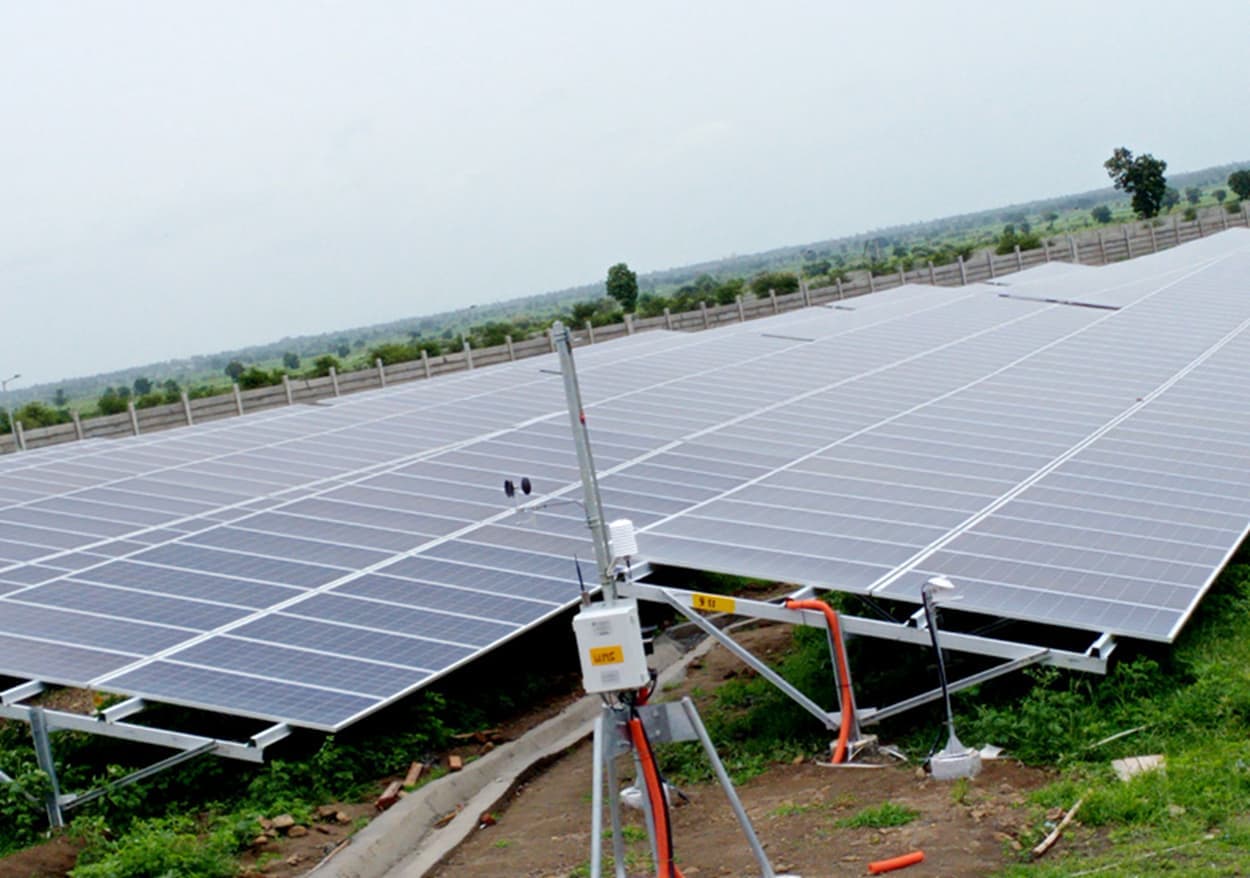
Fencing, water and a watch. An open plot needs a boundary wall or fence, a gate wide enough for a water tanker, and a water point for cleaning. Larger plants add a weather station, as in the photograph below, so that output can be checked against the sun the plant received.
What Verde Solaire's scope covers
Verde Solaire's services page lists the installation and commissioning scope its team takes responsibility for. On a ground-mounted plant it reads as follows.
- 01
Procurement help
Help with purchasing the material, or a handover to the supplier if you buy direct. - 02
Civil work
The foundations for the module mounting structure, designed for the soil on the plot. - 03
Structure
Erection of the galvanised iron structure at the chosen tilt and row spacing. - 04
Panels
Panel installation on the structure, with the strings laid out for the inverter design. - 05
Inverter and ACDB
Installation of the inverters and the AC distribution board. - 06
DC electrical work
Wiring of the whole DC side, from the strings to the inverters. - 07
Earthing
Earthing of the structure and the electrical equipment, as the site requires. - 08
Commissioning and handover
Final commissioning and handover of the plant.
The company is ISO 9001:2015 certified and is registered with IOCL, UHBVN, DHBVN, CEL, IPGCL, BRPL and CREST for solar power plant installations. The process from survey to handover is on how we work; after-sales cover is on warranty and after-sales.
Panel choice: mono, bifacial or poly
Verde Solaire's ground-mounted product page describes three panel types. Polycrystalline panels are the cheapest to make and the page puts their efficiency at 16 to 17%. Monocrystalline panels are cut from a single silicon crystal and the page gives 19 to 20%. Bifacial panels take direct light on the front and reflected light on the rear face. The company's June 2025 comparison for homes adds that bifacial panels reach 19 to 22% and give 10 to 15% more output when the installation lets light reach the back, and warns that on a flat concrete roof the gain may be small.
That warning matters on the ground too. Dark bare earth reflects little; a raised structure over light gravel, pale soil or grass gives the rear face something to see. Whether bifacial pays on your plot is a design question, and the quote should say which panel was assumed and why. Verde Solaire's recent installations have used Adani and Vikram modules of 530 to 545 Wp; the solar panels page explains what those names and figures mean.
Two compliance points apply to any grid-connected plant. GST on solar modules and devices is 5% (since 22 September 2025, down from 12%). For subsidised net-metering projects commissioned from 1 June 2026, the cells as well as the modules must be on ALMM List-II; the ALMM List-II page explains the lists.
Grid connection and the money
A ground-mounted plant connects to the grid the way a rooftop plant does, through the electricity board's net-metering or gross-metering application. In Uttar Pradesh, under the UPERC rooftop solar regulations of 2019, residential users may choose net or gross metering, and the DISCOM allows capacity within transformer limits. In Delhi, no feasibility study is needed up to 10 kW on the same supply type, and the DISCOM handles any load increase or transformer upgrade, and the July 2026 guidelines give the board 25 days to connect a plant above 10 kW. The net-metering section has the board-by-board process.
PM Surya Ghar is a residential scheme for a house with a suitable roof. Most ground-mounted plants sit at a factory, a school, a petrol pump or a farm on a commercial or institutional connection, where no capital subsidy applies and the case rests on the tariff the plant displaces; the commercial payback tool works that out from your load, tariff and plant size. Whether an array inside a house compound counts as a rooftop system under the scheme is decided by the electricity board at the feasibility stage, and this page does not claim an answer.
What Verde Solaire has built
Verde Solaire has delivered more than 50 MW of solar projects, with commercial installations up to 16 MW. The photographs on this page are from the company's own gallery. The projects section lists the published plants with their capacities, panels and inverters; the commercial and industrial and institutions pages cover the connection types most ground-mounted plants sit on.
Assumptions and limits
- Verde Solaire has published no per-kW price for ground-mounted plants. Each is quoted after a free site survey, and the written quote is the price.
- Panel efficiencies are as Verde Solaire published them on its product page and in its June 2025 comparison; the manufacturer's datasheet for the module named in your quote governs.
- Land, foundation and cabling needs depend on the plot; the survey replaces the general description above.
- Net-metering rules are from the UP Solar Energy Policy 2022, the UPERC regulations as summarised by a secondary source, and the DERC amendment of 26 July 2024 and guidelines of 16 July 2026. Eligibility for PM Surya Ghar is from the PIB backgrounder of 13 March 2025. Company facts are from Verde Solaire's own pages, fetched 18 September 2026.
Questions people ask
Start with a clear plan for your savings
Get a free roof assessment and a written quote for branded equipment. We will also explain the loan, installation, net-metering and subsidy steps.