
Solar for schools, colleges and institutions
Verde Solaire builds grid-connected solar plants for schools, colleges and government buildings, from 10 kW on a school roof to 170 kW at a divisional office. Its published record includes 350 kW installed across 29 schools and 3 colleges in one month under a West Bengal government programme, a 147 kW plant at C-MET Pune ordered through CPWD, and a 20 kW plant at NISST Punjab for Central Electronics Limited.
An institution is a different buyer from a homeowner: there is no household subsidy, the order often comes through a tender, and the load runs in daylight and stops at the weekend. This page covers what the company has built, how the arithmetic differs, what tenders check, and where an export limit is needed.
What we have built for institutions
Every project below is one Verde Solaire has published, in a customer's review or in its own updates. Where a make, a year or a result is missing, it has not been published, and the project page says so.
| Site | Capacity | Route to the order | What is published |
|---|---|---|---|
| School, Ayodhya | 20 kW | Direct | Installed four years before the review; bill reduced, in the school's words |
| College, Greater Noida | 35 kW | Direct, 2019 | "Working very well", with savings on the college's bill |
| NISST, Punjab | 20 kW | Order from Central Electronics Limited | On-grid plant on CEL panels; Verde Solaire is a CEL-registered firm |
| C-MET, Pune | 147 kW | Order through CPWD | Emmvee panels, Delta inverter; the electricity board's net meter was delayed |
| Patna division | 170 kW | Customer's tender | "Working well and giving desired generation" |
| 29 schools and 3 colleges, West Bengal | 350 kW in one month | State government programme | 10 kW per school, 20 kW per college, within a 2 MW rooftop project |
The West Bengal figures come from the company's update of 26 August 2024, which also said it was supplying panels, inverters and structures for a further 850 kW by the second week of that September. A November 2024 update repeated the pattern: 10 kW at schools, 20 kW at colleges.
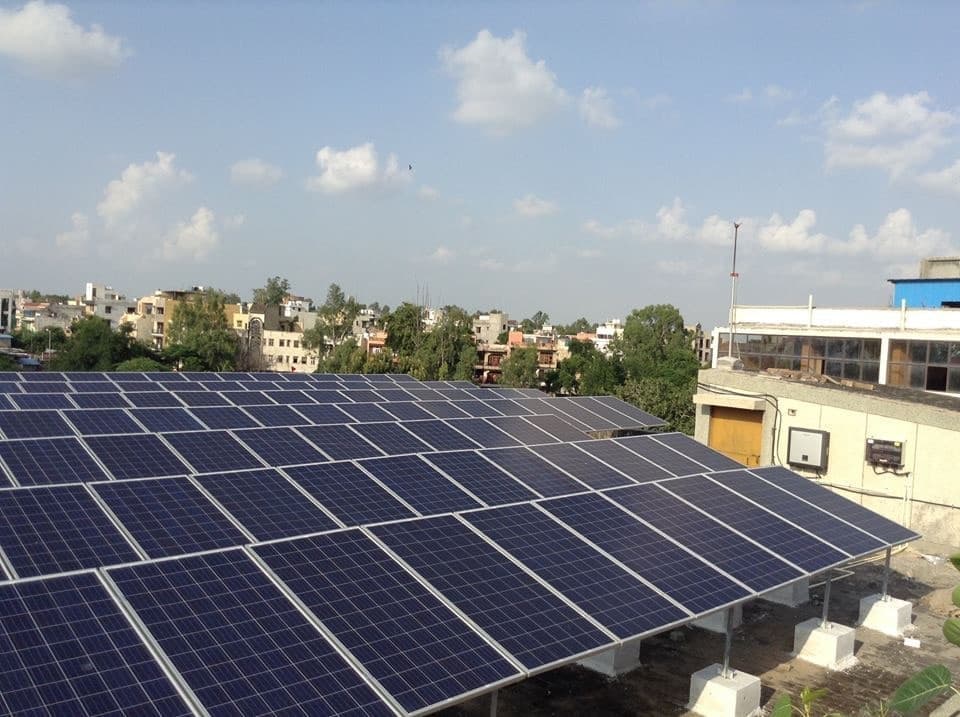
Across all its work the company reports more than 50 MW of solar projects, is ISO 9001:2015 certified, and works with a team with combined experience of more than 2,000 MW.
Why an institution's load suits solar
A school, college or office draws most of its electricity between morning and late afternoon: classrooms, laboratories, fans, lights, computer rooms and pumps run while the sun is up and are largely off at night. A home does the opposite, using much of its power in the evening and relying on net metering to bank the daytime surplus. An institution therefore consumes a large share of its own generation directly, and the metering arrangement matters less to the case.
The subsidy arithmetic is also different, because there is no subsidy. Eligibility under PM Surya Ghar: Muft Bijli Yojana is an Indian citizen who owns a house with a suitable roof, has a valid electricity connection and has not taken an earlier solar subsidy, which rules out a school, a college and a government office. An institutional plant is priced on the plant alone, with GST on solar equipment at 5% (since 22 September 2025, down from 12%). The case rests on three numbers: daylight units bought, the tariff paid for them, and the price per kW of the plant. The commercial payback model takes a monthly bill and a tariff and returns a payback estimate; the same arithmetic for factories and offices is on the commercial and industrial page.
Two features of institutional loads change the sizing. Schools close for summer holidays in the months of highest generation, and most institutions are shut on Sundays. A plant sized to the roof rather than the load exports heavily on those days, and what that earns depends on the board's rules. Size to the weekday daytime load and treat the holiday surplus as a bonus.
Net metering, export limits and zero-export
Where the electricity board allows net metering at the site, surplus generation goes to the grid and is set off against later consumption. In Delhi, the DERC guidelines amended in July 2026 set a connection timeline of 25 days for a plant above 10 kW, and credits roll over month to month, and any surplus left at the end of the financial year is paid at the DISCOM's average power purchase cost. At institutional size the board may ask for a feasibility check on the local transformer, and the sanctioned load sets the ceiling on capacity. The board pages for BSES Rajdhani, BSES Yamuna and Tata Power-DDL list what each asks for.
In Uttar Pradesh the licensee depends on the address: PVVNL for Noida city, NPCL for Greater Noida and Greater Noida West, PUVVNL for Varanasi. The Noida and Greater Noida net-metering pages set out the stages for each.
Some sites cannot export at all: the board may refuse net metering because the transformer is loaded, the connection may be on a tariff category the regulations do not cover, or a tender may specify that no power leaves the premises. The answer is a zero-export system. An export-limiting controller reads the meter at the point of supply and holds the inverter's output to what the building is using at that moment. The plant is then sized to the daytime base load rather than the roof, and the generation model must exclude the hours when the load falls below the plant's output; a zero-export plant built to a rooftop rule of thumb spends its holidays throttled.
Whichever route applies, the net meter is installed and sealed by the electricity board, not the installer. The C-MET Pune review records a long wait for the meter after Verde Solaire and CPWD had filed the documents on time. A tender timeline should allow for that stage.
How tenders and government orders work
Public bodies publish a tender that fixes the capacity, the technical specification, the warranty terms and the completion period, and check bidders against those conditions before price is opened. An award says as much about a firm's paperwork as its engineering.
Verde Solaire is registered with IOCL, UHBVN, DHBVN, CEL, IPGCL, BRPL and CREST for solar power plant installations. Three of its published institutional plants came through that kind of route: the Patna plant on the customer's own tender, the C-MET plant on a CPWD order, and the NISST plant on an order from Central Electronics Limited, whose officer wrote that "Verde is a CEL registered firm for solar panel installation and we were very happy with their work".
For an institution that is not tendering, the route is the one every customer gets: a free site evaluation and no-obligation proposal. The evaluation needs twelve months of electricity bills, the sanctioned load and tariff category, a look at the roof, and a decision on whether the plant must be zero-export. The proposal that follows names the make and model of every major component, the structure design, the metering route and the commissioning period.
What to write into a specification
Whether the document is a tender or a purchase order, the same lines protect the buyer.
- Modules and cells. For a net-metering plant commissioned from 1 June 2026, the cells must appear on ALMM List-II. Name the list, not a brand, so bids are comparable. ALMM List-II explained sets out what the list covers.
- Inverter. Make, model, number of units and the warranty in years; solar inverters explains the options.
- Structure. The design wind speed, the material and coating, and whether it is elevated; an elevated frame keeps a school terrace usable.
- Generation. A units-per-kW-per-year figure or capacity utilisation factor the plant will be measured against, and how. The Patna customer's remark that the plant gives the "desired generation" is a statement against such a figure.
- Metering. Who files the net-metering application, who follows it up, and what happens to the schedule if the board is late.
- Operation and maintenance. Cleaning frequency, fault response time and the service term; the maintenance page lists what a visit covers.
The eight checks that apply to any installer, institutional or not, are on how to choose a solar company.
What the institutions said
The two educational customers who wrote reviews describe plants that had run for years. Atul Singh wrote that the 20 kW plant at the Ayodhya school had been installed "four years back", that the installation "was very smooth", and that the school had "been able to reduce our electricity bill". Mr. P. Sharma wrote that the 35 kW system at the Greater Noida college, installed in 2019, "is working very well and has resulted in huge savings in electricity bill to the college". Both reviews are on the reviews page in full.
Commercial payback modelEnter the building's monthly units and tariff to see the payback for a plant sized to its daytime load.Open the toolQuestions people ask
Start with a clear plan for your savings
Get a free roof assessment and a written quote for branded equipment. We will also explain the loan, installation, net-metering and subsidy steps.