
Rooftop solar for homes, 1 to 50 kW
Verde Solaire installs home systems from 1 kW to 50 kW in Delhi, Noida, Greater Noida and Ghaziabad, with enquiries now open in West Bengal. The sizes most homes ask about are 3 kW and 5 kW. A 3 kW system costs ₹1,99,000 to ₹2,10,000 on our published price list and nets to ₹43,000 to ₹54,000 in Delhi or ₹91,000 to ₹1,02,000 in Noida after the central and state subsidy. That size suits a home using 300 to 400 units a month. A bigger bill, a builder floor or a flat changes the answer, and this page covers each case.
Which size fits your home
The government's own guide is 0–150 units a month: 1–2 kW · 150–300 units: 2–3 kW · above 300 units: above 3 kW. Take twelve months of bills, add up the units and divide by twelve, because a size chosen from a June bill will sit half idle in January.
- 1 kW and 2 kW suit small households and second homes using under 150 units a month, and the central subsidy covers a large share of the cost. See 1 kW and 2 kW.
- 3 kW is the most common choice in Delhi NCR. It generates about 338 units a month from about 300 to 350 square feet of shadow-free roof, and it is the size at which the central subsidy reaches its cap of ₹78,000. See 3 kW.
- 5 kW is for homes with three or more air conditioners running through the summer, or above 400 units a month. The subsidy is the same rupee amount as on 3 kW, so the net cost per kW is higher, but the bill it removes is larger. See 5 kW and 3 kW vs 5 kW.
- 10 kW and above are for large independent houses. We have published homes at 10, 12, 20 and 30 kW, all quoted per site because structure, cable runs and the inverter choice vary far more between roofs. See 10 kW.
The system size calculator turns your monthly units and roof area into a recommended size. An engineer then confirms it on the roof with a shadow analysis before anything is quoted.
The subsidy in Delhi and Uttar Pradesh
PM Surya Ghar: Muft Bijli Yojana pays ₹30,000 per kW for the first 2 kW and ₹18,000 for the third, so the central subsidy is ₹30,000 for 1 kW, ₹60,000 for 2 kW and ₹78,000 for 3 kW or anything larger. It is a fixed amount by capacity, not a percentage of your quote, and it is paid to your bank account after the net meter is commissioned.
Delhi adds ₹26,000 per kW, capped at ₹78,000 (3 kW), and then pays a generation-based incentive (GBI) of ₹3 per unit on home systems up to 3 kW for 5 years from commissioning, paid monthly against the bill; any excess to the bank account. On 3 kW the combined capital subsidy is ₹1,56,000. Uttar Pradesh adds ₹15,000 per kW, capped at ₹30,000 per consumer, on top of the central subsidy, so a home in Noida or Ghaziabad receives ₹1,08,000 on 3 kW. West Bengal currently has no state top-up.
Not yet official. Confirmed by Verde Solaire on 20 September 2026. We are awaiting the updated government notification to replace this client-confirmed figure with the official source.
Not yet official. Confirmed by news reports in September 2026; UPNEDA's site did not load when we checked, so there is no official 2026 confirmation.
To qualify you must be an Indian citizen who owns a house with a suitable roof, has a valid electricity connection and has not taken an earlier solar subsidy; both the modules and the cells must be made in India; and the installer must be a vendor registered on the national portal, and you choose the vendor on pmsuryaghar.gov.in. Verde Solaire is a registered PM Surya Ghar vendor in both Delhi and Uttar Pradesh. The subsidy guide has a page for each state, the eligibility checker takes two minutes, and who pays whom explains why you pay the installer and the government pays you.
Delhi's Cabinet also approved, on 1 September 2026, a scheme for households that averaged 400 units a month or less in FY 2025-26. Its rules had not been published when we checked; the Delhi zero-upfront page lists what is known and what is still open.
Not yet official. Cabinet-approved on 1 September 2026 and reported by the press; the notification and operating rules had not been published when we checked on 16 September 2026. The official Delhi portal still shows the July 2025 figures.
Independent houses, builder floors and society flats
An independent house is the simple case. The roof is yours, the connection is yours, and in Delhi no feasibility study is needed up to 10 kW on the same supply type, and the DISCOM handles any load increase or transformer upgrade. The application goes through the national portal like any other.
A builder floor needs two things settled before the survey: the right to use the terrace, in writing, from the other owners, and a look at the sanctioned load on your connection. BSES Rajdhani's FAQ says a consumer may install up to or beyond the sanctioned load, with service-line charges above it. The full picture, including who signs when a terrace is shared, is on solar on builder floors and shared roofs.
A flat in a society has two routes. The society can put a common-area plant on the shared roof under the RWA provisions of PM Surya Ghar, which pay ₹18,000 per kW for common facilities, up to 500 kW (3 kW per house), EV charging included; Delhi adds ₹2,000 per kW, up to 500 kW. That plant reduces the society's common-area bill, not the bill for your flat. In Delhi there is now a second route: the Seventh Amendment of 20 January 2026 opens virtual net metering to all Delhi consumers, with DISCOMs bearing line and network costs up to set caps, so a group of flat owners can share one plant and have its generation credited to their own connections in an agreed proportion. We have not verified an equivalent in Uttar Pradesh. The housing societies page covers both routes.
What an installation includes
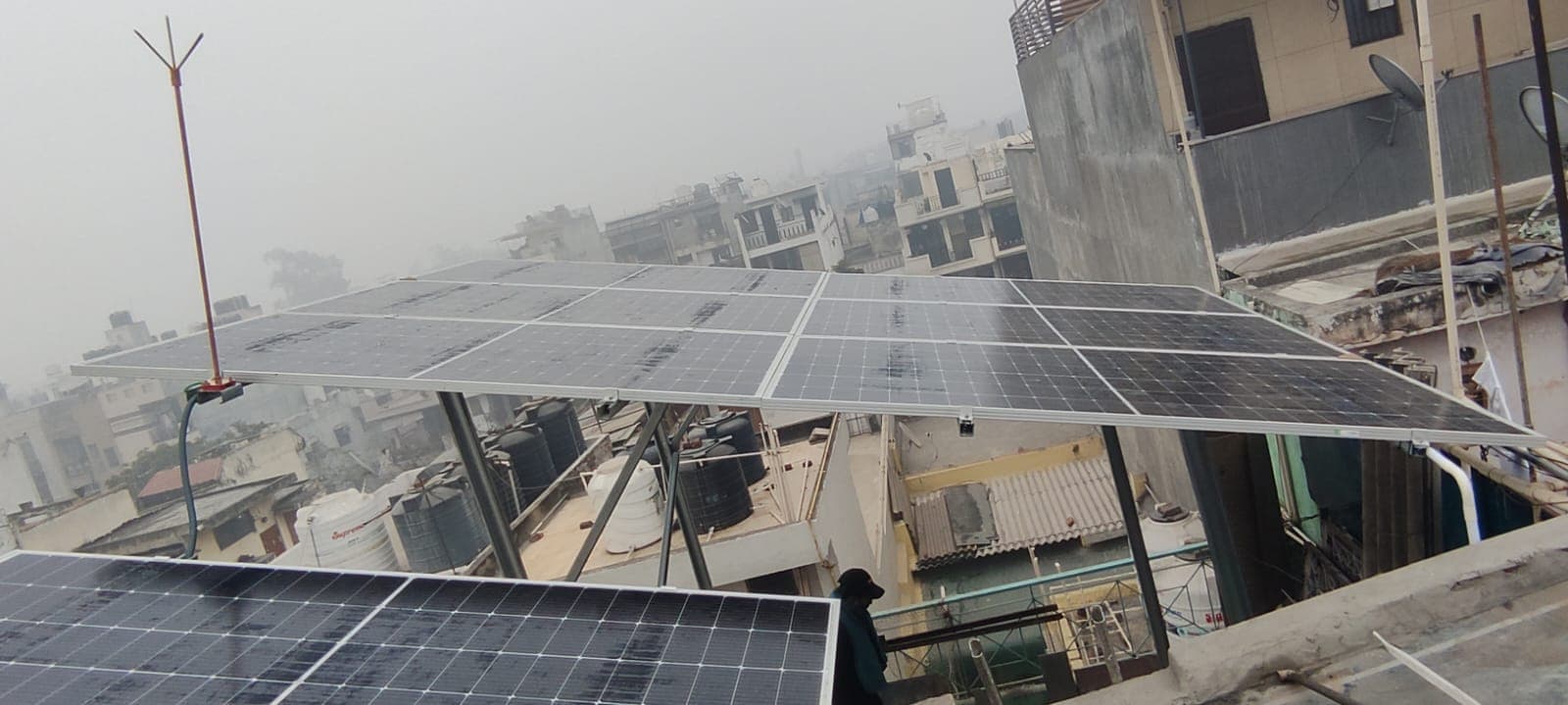
The published price for 1 to 5 kW covers panels, inverter, mounting structure, net metering, installation and warranty. On a home roof that scope means:
- Modules. Recent home installations in Noida and Delhi used Adani and Vikram Solar modules of 530 to 545 Wp. The quote names the make, model and wattage so you can check them against ALMM List-II, which has applied to net-metering projects since 1 June 2026. A 3 kW system needs six panels of this size.
- Inverter. An on-grid string inverter matched to the array; recent homes used KSolare and Delta.
- Structure. A galvanised steel mounting structure, raised where the customer wants the terrace usable underneath. The 10 kW Janakpuri system was built on an elevated structure, and the 30 kW residence needed a structure designed so that it did not disturb the exterior of the house.
- Cabling, earthing and protection. DC and AC cabling, earthing for the array and the inverter, and the protection devices the electricity board inspects before it commissions the meter.
- Net metering. We file the PM Surya Ghar application, submit the plant details, attend the inspection and follow the bidirectional meter through to activation. In Delhi the regulator now sets 10 days for a connection up to 10 kW, with no application fee for domestic consumers.
- Subsidy claim. After commissioning we upload the bank details and the claim. The official payout is "within 30 days" of the claim; about 15 days on average.
Before any of that, an engineer visits for a free site evaluation and no-obligation proposal, including the shadow analysis. The July 2025 price posts state 25-year performance warranties on all three panel types; the inverter and workmanship terms are set out in the written quote.
On-grid or hybrid
Every system described above is on-grid. It feeds the house by day, exports the surplus through the net meter, and switches off during a power cut because the inverter must not push power into a dead line. If outages are your reason for going solar, you need a hybrid inverter and a battery, which costs more and is not what the published prices describe. The trade-off, and when an ordinary inverter-battery set is the better buy, is worked through on rooftop solar or inverter battery and the off-grid and hybrid page.
Homes we have installed
Published residential work includes a 10 kW system at Greater Kailash on Adani 530 Wp bifacial modules, a 10 kW system at Janakpuri on Vikram modules with a KSolare inverter, a 30 kW residence, homes of 4, 6, 7, 9 and 20 kW across Noida including Sectors 25 and 41, and a 2 kW PM Surya Ghar system in Varanasi on Adani 540 Wp modules. The projects section has a page for each.
The oldest of these are the useful ones. S. C. Garg, whose Greater Kailash system was installed when the company still traded as Sirius Electric, wrote that it had been "working continuously without a single day breakdown since 2017". Two Delhi customers say the same thing in different words: the installation was quick, and the only wait was the electricity board's net meter, about which the team kept them informed.
“I got my 6KW solar power plant installed from Verde Solaire Pvt Ltd. They have done a very professional work and I was surprised by the speed of their execution. I was also able to get solar subsidy in record time because of the follow up of the team of Verde Solaire. They are the best solar power plant installation company in Noida and are highly recommended for this work.”

Mr. L. R. Singh 6 kW · Noida
“I have installed solar system of 7 KW at my Sector 41, residence in Noida through Verde Solaire Pvt. Ltd. The workmanship and the service provided by the Verde Solaire team was exemplary. They completed the installation in record time. Verde is recommended by us for installing solar system.”

Aurbind Sharma 7 kW · Noida
“A 9 KW solar power plant was installed by Verde Solaire at my Noida residence. Verde and its people were very cooperative throughout the work and actively got the work done. I am very happy with the installation processes and workmanship of Verde and would recommend them for good quality solar plant installation.”

Solar power plant at residence 9 kW · Noida
“I got a 10 KW solar system installed at my house in Janakpuri, New Delhi from Verde Solaire Pvt. Ltd. I used Vikram solar panels and KSolare inverters with an elevated module mounting structure. The installation of solar plant by Verde was of very good quality and their installation of solar system was also very quick. However the net metering process was delayed by the Discom and the electricity department has to look into this. I would recommend Verde to everyone who wants to install solar plant and save on their electricity bill.”

Navin Verma 10 kW · New Delhi
“I had installed solar plant from Verde (formerly Sirius Electric) more than five years back at my GK, New Delhi residence. This was a very good decision, as my electricity bill has been low since then. Verde (formerly Sirius) had used such good materials that the solar system has been working continuously without a single day breakdown since 2017. The solar plant installed at my place is maintenance free. I have recommended installation of solar system from Verde Solaire to many of my friends and neighbours in New Delhi NCR.”

Mr. S. C. Garg New Delhi
“Solar rooftop energy system of 10 KW was installed by Verde Solaire at my GK1, New Delhi residence. I am very happy with the professional services provided by the company. We had agreed for 530W Mono Perc Adani solar panels for my solar energy system, but they installed a better bifacial solar panel of Adani without charging anything extra from us. Verde Solaire in my opinion is one of the best solar plant installation company in Delhi NCR. The processes were simple and they have also helped in applying for central subsidy for solar power plant. This company is highly recommended by us for installation of solar power plant.”

Mr. Jai Kumar Manghnani 10 kW · New Delhi
Paying for it
There are three ways. Pay in full against the milestones set out in the quote. Take the PM Surya Ghar concessional loan, which is collateral-free, from nationalised banks, at repo rate plus 0.5 percentage points, 5.75% on 28 July 2026, over 10 years; Verde Solaire has tie-ups with SIDBI, SBI and other NBFCs for collateral-free solar loans and prepares the paperwork with you. Or, in Delhi, wait for the zero-upfront scheme if your usage is within its limit and you are prepared to wait for rules that are not yet published. The EMI calculator and the solar loan page cover the first two.
Questions people ask
Start with a clear plan for your savings
Get a free roof assessment and a written quote for branded equipment. We will also explain the loan, installation, net-metering and subsidy steps.